Malabar Muslim heritage is one of the most distinctive cultural strands in Kerala. It was shaped not by conquest or imperial imitation, but by maritime trade, neighborhood life, scholarship, craft, and a long process of cultural blending along the Arabian Sea coast. That history still survives in streets, prayer halls, woodwork, waterfront quarters, and old trading towns where memory feels close to the present.
What makes this heritage especially compelling is the architecture. Historic mosques in the Malabar region often do not match the image many travelers expect when they think of Islamic monuments in India. Instead of large domes, tall minarets, and expansive stone courtyards, many older Malabar mosques are rooted in Kerala’s own building traditions. Timber roofs, layered eaves, carved details, sloping forms, and temple-like facades give them a regional identity that is unmistakable.
Malabar Muslim heritage and the coastal trade story
The story begins with trade across the Indian Ocean. Arab merchants had commercial ties with Kerala from an early period, and historical accounts place Islam in Kerala as early as the 7th century CE. Coastal ports on the Malabar Coast became contact zones where goods, languages, faith, and social customs circulated with remarkable intensity.
Kodungallur is central to this early history. It is associated with Cheraman Juma Masjid, widely recognized by Kerala Tourism as the first mosque built in India, traditionally dated to 629 CE. Whether one approaches it as a sacred site, a historical landmarks a historical landmark, or an architectural archive, the mosque points to a striking fact: Islam in Kerala took root through exchange and settlement, not through the architectural formulas seen in later Indo-Islamic capitals.
Kozhikode became another major center. As trade expanded, Muslim communities grew in port towns, and the Mappila community developed a rich cultural identity shaped by religion, local language, commerce, and shared regional aesthetics. Malabar Muslim heritage, then, is not only about old mosques. It includes food traditions, neighborhood patterns, literary culture, maritime links, and a style of building that reflects long coexistence with Kerala’s social and material environment.
Why Malabar mosque architecture looks different
Many historic mosques in Malabar are visually closer to Kerala temple and vernacular architecture than to Mughal or Sultanate mosque styles from northern India. This is one of the most important features of the region’s built heritage.
Kerala Tourism and academic studies both describe these mosques as timber-based, locally adapted structures. Builders used techniques that already made sense in a monsoon-heavy landscape. Sloping roofs handled rain efficiently. Timber framing suited available skills and materials. Laterite, where used, fit the local construction ecology. The result was a mosque architecture that was fully Islamic in liturgical function while thoroughly Kerala in form.
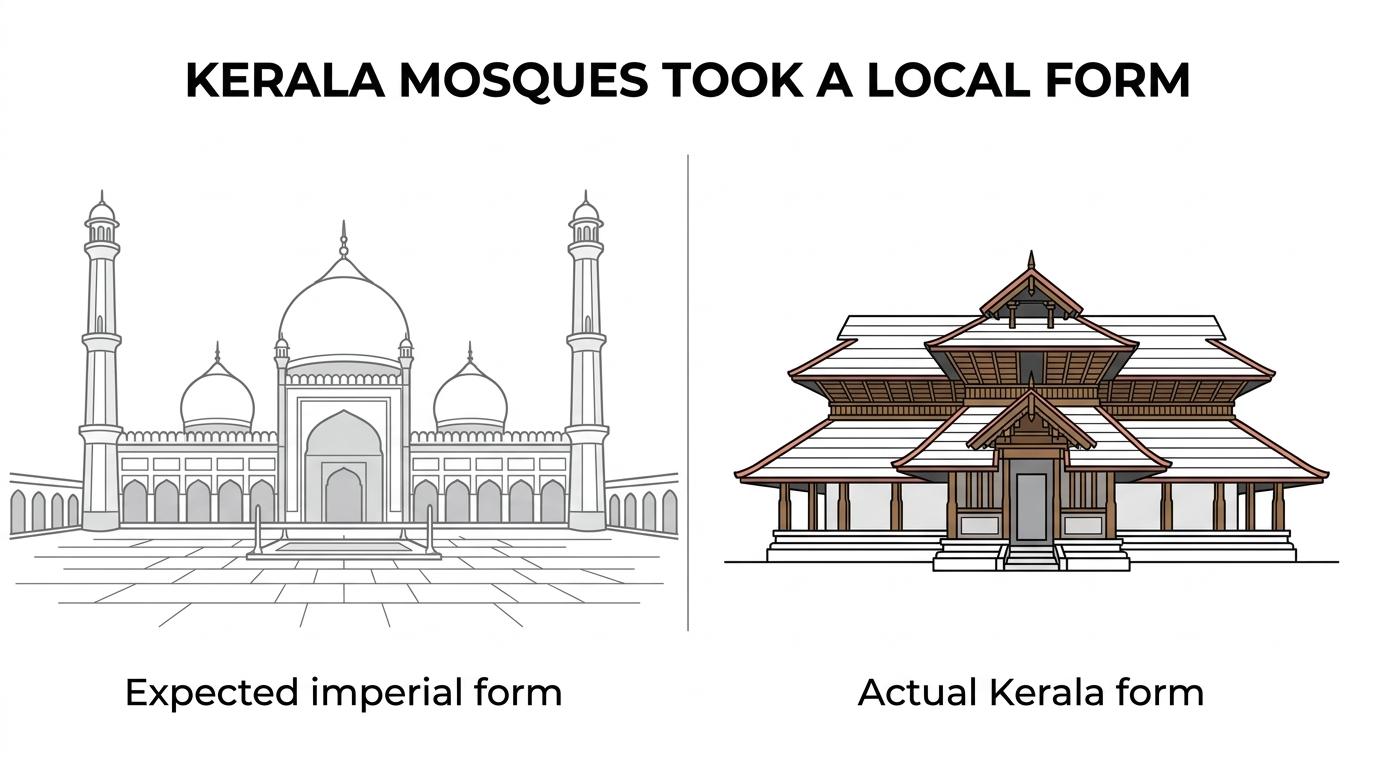
That is why many older Malabar mosques have no prominent dome and no towering minaret. Their religious identity lies inside the prayer layout, the mihrab, the pulpit, and the orientation of worship, while the exterior speaks the language of the region.
| Feature | Historic Malabar Mosques | More Familiar Imperial Indian Mosque Form |
|---|---|---|
| Roof shape | Sloping, tiered, rain-friendly roofs | Domes or flat terrace systems |
| Main materials | Timber, laterite, lime, tile | Stone, marble, plaster, brick |
| Visual character | Vernacular Kerala style | Monumental courtly style |
| Minarets | Often absent in older examples | Often prominent |
| Decorative influence | Carved wood, local motifs, temple parallels | Arches, domes, geometric and calligraphic emphasis |
| Climate response | Strong adaptation to monsoon conditions | Varies by region and dynasty |
This architectural difference is not a lesser version of Islamic design. It is a confident regional expression of it. The buildings show how faith traditions can settle into local environments and produce something original, durable, and beautiful.
Key architectural features of Malabar mosques
The most memorable Malabar mosques reward slow looking. Their significance does not always announce itself from a distance. It appears in proportion, craftsmanship, structural logic, and the quiet authority of materials.
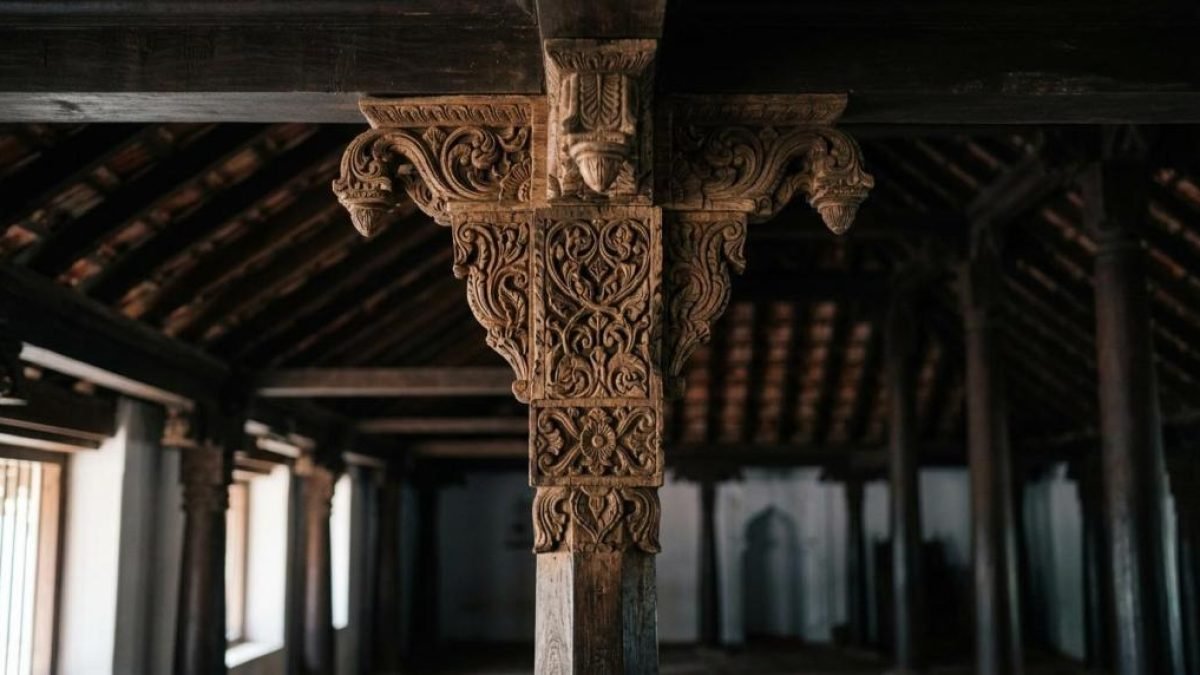
A visitor often notices the roof first. Multi-tiered, deeply projecting, and carefully balanced, the roofline is one of the clearest signs of Kerala influence. Timber is another defining element, not only as structure but as ornament. Historic prayer halls may include carved brackets, ceiling panels, beams, and screens that reveal highly skilled local workmanship.
Inside, the sacred arrangement remains distinctly Islamic. The mihrab marks the direction of prayer, and the pulpit serves liturgical needs. That contrast matters. Externally, the mosque belongs to Kerala’s architectural landscape. Internally, it remains organized around Muslim devotional practice.
Several recurring traits help identify this regional style:
- sloping tiled roofs
- deep eaves
- timber columns
- carved wooden ceilings
- laterite or masonry base walls
- restrained exterior massing
A few details deserve special attention when visiting a historic site:
- Facade language: Temple-like fronts, layered entry compositions, and arch forms that may resemble local sacred architecture
- Climate adaptation: Ventilation, shade, and roof geometry shaped by heavy rainfall and humidity
- Interior focus: The mihrab and pulpit define the prayer space even when the exterior avoids standard mosque silhouettes
- Material intelligence: Timber-laterite construction reflects both craftsmanship and ecological fit
Cheraman Juma Masjid and the early history of Islam in Kerala
Any discussion of Malabar Muslim heritage benefits from including Cheraman Juma Masjid, even though Kodungallur sits slightly south of what many travelers think of as northern Malabar. Its historical weight is immense.
Kerala Tourism recognizes it as the first mosque built in India, dating to 629 CE. The structure is also noted for blending traditional Kerala and Middle Eastern elements, with a facade that recalls a temple form. That alone captures the larger pattern of Islam in Kerala: early arrival, local adaptation, and an architectural language shaped by coexistence rather than separation.
Today, the site carries added importance through the Islamic Heritage Museum developed under the Muziris Heritage Project. This expands the experience beyond worship and architecture into a broader historical frame, linking the mosque to trade routes, settlement patterns, and centuries of intercultural contact.
Mishkal Mosque in Kozhikode and the power of timber architecture
If one building captures the drama and individuality of Malabar mosque architecture, it is Mishkal Mosque in Kozhikode. Located in the Kuttichira area, it is among the best-known heritage mosques in Kerala and one of the most striking examples of a multi-storeyed timber mosque on the Malabar Coast.
Kerala Tourism notes that the mosque was originally five storeys high and built of timber. It was damaged during the Portuguese attack of 1510 and later repaired by the Zamorin, the Hindu ruler of Calicut. That episode alone says much about the region’s social history. Political conflict, commercial importance, and intercommunal patronage are all embedded in the building’s story.
Its architectural profile is especially revealing. Mishkal Mosque has no cupolas and no minarets. Instead, it presents a layered Kerala form, with carved wooden elements and entrance features described as having Gopuram-style arches. This is not accidental resemblance. It reflects a built environment in which local artisans, local materials, and local visual habits shaped even sacred architecture tied to a global religion.
Academic work also highlights Mishkal Mosque as one of the earliest multi-storeyed mosques on the Malabar Coast, generally dated to the early 14th century. It stands as proof that vernacular architecture can be both technically sophisticated and historically significant.
Kuttichira Jama Palli and the old Muslim quarter in Kozhikode
Kuttichira is one of the richest places in Kerala for reading Muslim urban heritage at street level. It is not only a mosque precinct but a lived historical quarter where architecture, memory, and everyday rhythm still intersect.
Kuttichira Jama Palli is often identified as a 14th-century mosque and is noted by Kerala Tourism as having the largest floor area among mosques in Kerala, with capacity for around 1,000 worshippers. Wood was used extensively in its construction, which reinforces the larger architectural pattern seen across the region.
The wider neighborhood matters just as much as the individual monument. In Kuttichira, the mosque is part of an older mercantile landscape. Streets, water bodies, homes, trading memories, and communal institutions all give context to the prayer spaces. This is where Malabar Muslim heritage becomes vivid. It is not preserved behind glass. It continues through living neighborhoods.
Travelers who want a fuller cultural experience often benefit from including places like Kuttichira, Mishkal Mosque, and nearby heritage streets within a guided Kozhikode visit. When interpreted well, these sites open up a much richer view of Kerala than the standard coast-and-hill itinerary.
Mappila mosque architecture as a Kerala cultural expression
The phrase “Mappila mosque architecture” is useful because it names a regional tradition rather than forcing these buildings into categories shaped elsewhere. Kerala Tourism describes this architecture as a sign of how Muslim communities became part of Kerala’s cultural fabric while remaining distinct in faith and ritual practice.
That dual identity is what gives the architecture its strength. The mosques resemble local sacred buildings in many visual respects, yet their interiors are arranged around Islamic worship. The buildings do not hide their setting, and they do not abandon their religious purpose. They hold both realities at once.

This has wider implications for anyone interested in heritage studies, architecture, or South Indian history. Malabar mosques challenge the habit of treating religious architecture as a fixed visual code. They show that sacred form can be regional, climate-responsive, and deeply local without losing theological clarity.
Visiting Malabar Muslim heritage sites with context and respect
These are active religious places as well as historical landmarks. A thoughtful visit makes the experience far more meaningful.
A few practical habits help:
- modest clothing
- quiet observation
- permission before photography
- respect for prayer times
- local guiding when available
It also helps to approach the sites as part of a network rather than isolated monuments:
- Historical lens: Link each mosque to trade, port cities, and the Indian Ocean world
- Architectural lens: Notice the roof, timber work, facade composition, and absence of standard dome-minaret symbolism
- Community lens: Pay attention to surrounding streets, markets, tanks, schools, and neighborhood patterns
- Travel planning lens: Combine Kozhikode, Beypore, Thalassery, Kannur, and related heritage stops for a more coherent regional picture
For travelers interested in customized heritage travel through Kerala and South India, Malabar can be shaped into a focused cultural route rather than a quick stop. Well-planned itineraries often work best when they combine mosque architecture, old port towns, food traditions, and local interpretation, allowing the region’s Muslim heritage to appear in its full historical setting rather than as a single monument visit.
That is where Malabar leaves a lasting impression: in the way faith, craftsmanship, climate, and commerce come together so naturally that the architecture feels both deeply rooted and quietly original.