
Kerala’s matrilineal past is one of the most distinctive social histories in South Asia. It is often reduced to a single idea, women inherited property, but the reality was much richer and much more structured. What existed in many parts of Kerala was not just a family habit. It was a full kinship order with legal force, a household system, and a way of organizing property, authority, and belonging.
The best-known name for this system is marumakkathayam. It is closely associated with Nayar communities, yet historical records show a wider spread that also included Thiyya, Ezhava, Mappila Muslim groups in Malabar, and even some Brahmin contexts. That broader view matters, because it shifts the story away from a narrow community label and toward a regional pattern that shaped Kerala’s social fabric for centuries.
Kerala matrilineal history and the meaning of marumakkathayam
In Kerala, matriliny usually meant descent and inheritance through the female line. Under marumakkathayam, property moved through a man’s sisters and their children rather than to his own children. This principle shaped landholding, residence, guardianship, and everyday family expectations.
The household unit most closely tied to this system was the taravad, an extended matrilineal family estate and residence. A taravad could include several generations linked through women, all connected to a shared ancestral house and common property. The senior male manager was often called the karanavar, and he exercised authority over family affairs, property decisions, and, in many cases, dispute settlement.
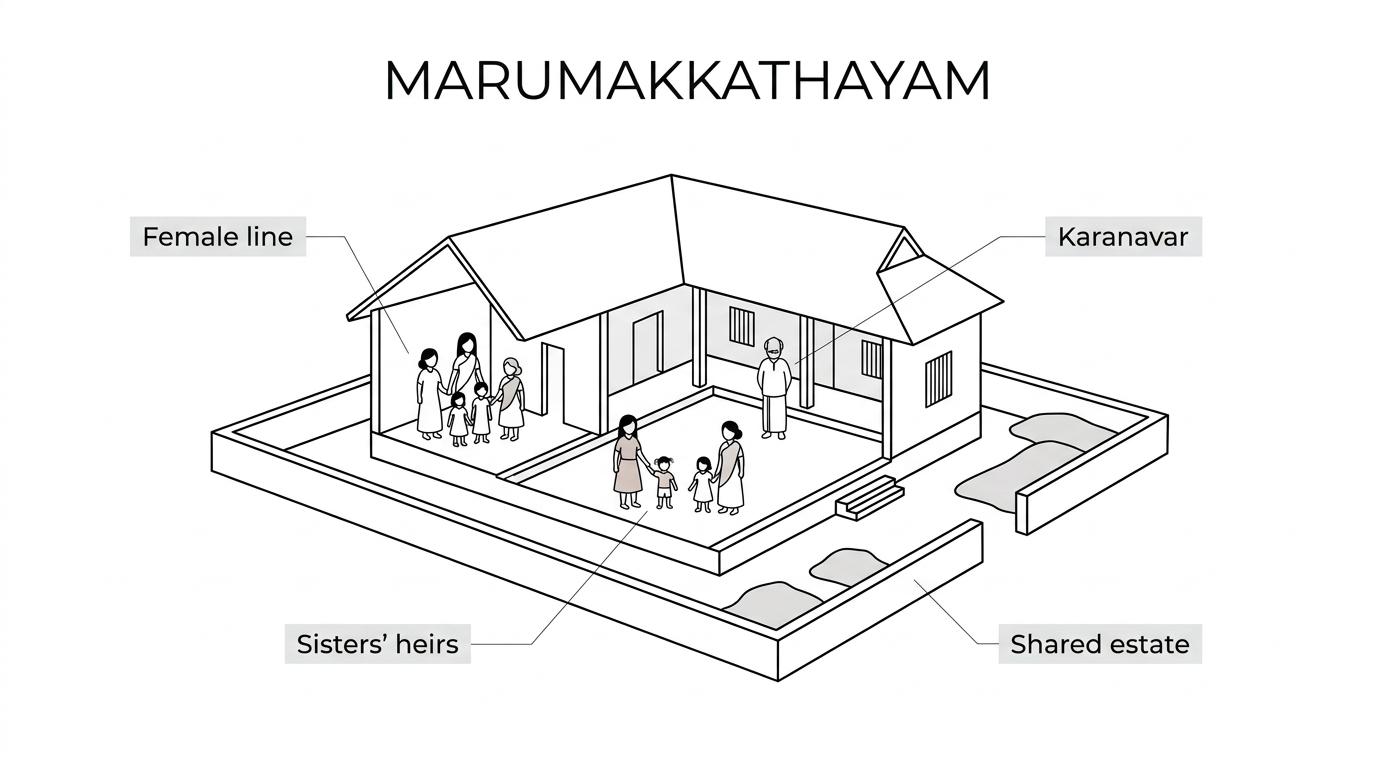
That point is worth sitting with for a moment. Kerala’s matriliny was not simply “rule by women.” Women were central to lineage and inheritance, yet authority inside the taravad was often exercised by the mother’s brother or another senior male in the matriline. So the system was matrilineal, not always matriarchal.
A few core features help explain how it worked:
- descent through the mother’s line
- inheritance by sisters’ children
- taravad-based shared property
- authority of the karanavar
- strong links between kinship and land
Taravad households in Kerala and how family authority worked
To picture a taravad, imagine more than a nuclear family living around one ancestral center, materially and symbolically tied to the same property. The house was not just a residence. It represented continuity, security, ritual identity, and status. Membership in the taravad shaped a person’s place in the social order from birth.
This arrangement also changed the role of fathers in everyday legal life. A man’s relationship with his own wife and children could be socially meaningful and emotionally close, but in the classic form of marumakkathayam, his legal heirs in ancestral property were often his sisters’ children. His natal taravad remained a primary point of obligation. That is one reason the maternal uncle appears so prominently in Kerala’s older kinship memory.
The internal structure could be stable, though not always simple. Shared property created mutual support, but it could also create tension over management, partition, marriage arrangements, and individual autonomy. As the twentieth century progressed, many people began pressing for reforms that would give smaller family units more control over assets and succession.
Communities in Kerala that practiced matriliny beyond the Nayar story
Popular accounts often treat matriliny in Kerala as if it belonged only to Nayars. That picture is incomplete. Historical scholarship and legal records point to a wider spread of matrilineal practice, though forms varied by region, caste, and religious community.
Among Thiyya groups, studies of twentieth-century households show a more layered social reality than old stereotypes suggest. In some cases, matrilineal rights existed alongside virilocality, meaning a married woman might live in her husband’s house while still retaining rights in her natal taravad. That alone challenges a simplistic before-and-after script in which matriliny vanished overnight and was replaced by a fully patrilineal order.
Mappila Muslim communities in parts of Malabar also preserved matrilineal inheritance patterns in certain local settings. Ezhava communities in some areas had related systems recognized in law. Even some Brahmin contexts appear in historical discussion, especially when medieval inheritance and ritual practice are considered. The point is not that every group practiced the same custom in the same way. The point is that Kerala’s matriliny was a broad regional formation with local variation.
That wider scope can be sketched simply:
- Nayar communities: the best documented and most frequently discussed examples
- Thiyya households: matriliny combined at times with virilocal residence patterns
- Ezhava groups: community-specific legal recognition in the modern period
- Mappila communities: matrilineal inheritance in parts of Malabar, later addressed through statute
Why historians still debate the origins of Kerala matrilineal history
The origins of marumakkathayam remain debated. There is no single explanation accepted by everyone. That is common in social history, especially when a system developed over a long period and across different regions.
One frequently cited explanation links matriliny to relations between Nambudiri Brahmins and Nayar elites, often described through the language of hypergamy. Another line of argument points to the long absences of Nayar men in military service, which may have strengthened residence and inheritance patterns centered on the mother’s line. These are influential interpretations, yet they do not close the question.
What matters more than chasing one neat origin story is recognizing how firmly the system took root. By the medieval and early modern periods, matriliny in Kerala had legal, economic, and ritual dimensions. It governed succession, shaped household structure, and influenced the way people thought about lineage itself.
Legal force of marumakkathayam in Kerala society
One of the biggest misconceptions about Kerala matriliny is that it was only a social custom with no formal standing. In fact, it had real legal weight. Colonial courts, regional administrations, and later legislatures treated it as a system that required definition, regulation, and reform.
That legal recognition matters because it shows how deeply embedded the system was. Property disputes, partition rights, household authority, and succession could not simply be left to vague tradition when landholding and family interests were involved. Statutory change became a way to reshape society.
The table below gives a quick view of the social and legal architecture of the system.
| Element | Kerala matrilineal meaning | Social effect |
|---|---|---|
| Marumakkathayam | Descent and inheritance through the female line | Kept property within the matriline |
| Taravad | Joint matrilineal household and estate | Created shared residence, identity, and assets |
| Karanavar | Senior male manager of the taravad | Concentrated managerial authority |
| Sisters’ children as heirs | A man’s principal heirs in ancestral property | Reduced inheritance claims of his own children in the classic system |
| Community statutes | Laws governing matrilineal groups in different regions | Turned kinship practice into legally defined structure |
Colonial and postcolonial laws that changed Kerala family inheritance
By the late nineteenth and early twentieth centuries, pressure for reform had intensified. Critics argued that large joint families limited individual control over wealth, slowed property transactions, and created disputes over management. Reformers also framed change in moral and domestic terms, favoring the conjugal family over the taravad.
This did not happen through a single law. It unfolded through a sequence of community-specific acts in different parts of Kerala under British, princely, and later state legal regimes. Statutes addressed Nayar, Ezhava, Mappila, and other matrilineal groups separately, gradually narrowing the older system.
Several changes were especially significant:
- Partition rights: taravad property could increasingly be divided among members
- Conjugal claims: husbands, wives, and children gained greater legal visibility
- Community legislation: different regions passed separate acts rather than one uniform code
- State abolition: later legislation repealed many earlier matrilineal statutes
A major turning point came with the Kerala Joint Hindu Family System (Abolition) Act, which repealed earlier laws including the Madras Marumakkathayam Act of 1932, the Cochin Nayar Act, the Travancore Nayar Act, the Travancore Ezhava Act, and the Cochin Marumakkathayam Act, among others. In legal terms, the old framework was not merely fading away. It was being actively dismantled and replaced.
What changed for women, men, and property in Kerala after reform
It is tempting to think of reform as a simple shift from “old tradition” to “modern family.” The actual social change was more mixed. Some people gained individual rights and direct control over property. Nuclear households became stronger. Fathers and their children came to occupy a clearer legal unit. Yet something else was also altered: the old security offered by the natal taravad could weaken when joint property was partitioned.
For women, the results were not uniform. In some settings, reform made room for smaller households and clearer marital rights. In others, the decline of shared matrilineal property reduced the material strength that residence rights in the natal home had once provided. This is why some scholars are careful not to describe the shift as a clean move from female-centered security to male-centered modernity, or the reverse.
The Thiyya example is especially useful here. Research on twentieth-century tharavad houses shows that virilocal marriage and matrilineal rights could coexist. A woman might move after marriage, yet still retain rights in her natal house and property. That complicates any easy claim that matriliny simply disappeared the moment residence patterns changed.
Reading Kerala’s landscape through matrilineal history
Kerala’s matrilineal history is not locked away in legal archives. It still lingers in old houses, property stories, family names, and the way many people speak about ancestral homes. A traveler moving through Malabar or central Kerala may hear references to taravads long before hearing the term marumakkathayam explained in a formal way.
That makes the subject especially rewarding for anyone interested in culture and place. Family history in Kerala is often tied to architecture, land boundaries, temple patronage, local memory, and community identity. A heritage-minded trip can become much richer when these layers are visible.
When people look for traces of this past, they often notice:
- ancestral compounds and tharavad houses
- stories about maternal uncles and lineage property
- local discussions of partition and inheritance
- community memories that do not fit one simple model
Why Kerala matrilineal history still matters in serious cultural study
This history matters because it broadens the way Kerala is seen. The state is often celebrated for literacy, social development, and landscape, yet its older kinship structures deserve equal attention. They show that family systems can be highly organized, legally recognized, and very different from modern assumptions about inheritance.
They also remind us to avoid neat labels. Kerala’s matriliny was not a curiosity at the edge of society. It was a durable regional order. It included multiple communities, carried legal force, and changed through debate, legislation, and shifting domestic ideals.
For readers, researchers, and culturally curious visitors alike, that insight opens a better way of seeing Kerala: not as a place with one fixed social past, but as a region whose households, laws, and identities were shaped by a remarkable matrilineal tradition and the powerful reforms that followed.