
Few art forms announce themselves as powerfully as Kathakali. Before a single gesture is read, the face makeup, layered costume, towering headgear, percussion, and stillness of the performer set the tone. Watching it for the first time in Kerala can feel both theatrical and ceremonial, which is part of its hold on audiences from around the world.
For travelers, the practical question is usually simple: Where should I go, and how should I watch it so I actually understand what I am seeing? The best short answer is Kochi, especially Fort Kochi, where Kathakali is regularly presented for visitors. Official Kerala tourism sources also point to Ernakulam and Bolgatty Palace in Kochi as places associated with cultural performances. If you want a reliable starting point, Kochi is one of the clearest choices.
What Kathakali is in Kerala’s performance tradition
Kathakali is a classical dance-drama tradition from Kerala, tracing its origins back to the dramatic forms of krishnanattam and Ramanattam in the 17th century. UNESCO identifies it as a form that combines storytelling, dance, and theatre, usually drawing from mythological stories like the Ramayana and Mahabharata. This matters because Kathakali is not built like a casual dance recital. It is a narrative form, and every movement serves the story.
Official Kerala tourism material describes Kathakali as a highly structured theatrical tradition with defined training and presentation patterns. Music and rhythm are central to the experience, including Kerala’s indigenous rhythmic systems and the traditional sopanam style of singing. Even if you do not follow the language or every symbolic detail, the emotional force comes through clearly.
A useful thing to know before you book a show is that Kathakali was traditionally not a short-format stage item. It was often performed as an overnight play, and some stories unfolded over several nights. That traditional scale explains why even today, a brief tourist performance is only one possible way to experience it.
Why Kathakali feels different from other stage performances
Many first-time viewers expect an Indian dance show. What they find instead is a dance-drama that serves as a total performance language. The eyes, eyebrows, fingers, torso, footwork, costume, makeup, singers, and percussion all work together.
That is why Kathakali rewards patient viewing. It asks you to watch closely rather than consume quickly. A small change in expression can mark pride, anger, grief, triumph, or deception. The performer is not decorating the story. The performer is the story.
If you want to get more from the evening, watch for these elements:
- Facial expression
- Eye movement
- Hand gestures
- Drum patterns
- Costume color coding
- The shift between stillness and sudden intensity
How traditional Kathakali and visitor performances differ
For travelers, the most common format is an evening cultural performance, which provides an engaging introduction to the rich culture of Kerala. These are often curated to be easier for new audiences, sometimes with a short introduction, a makeup demonstration, or selected scenes instead of a full-night drama. That can be an excellent entry point.
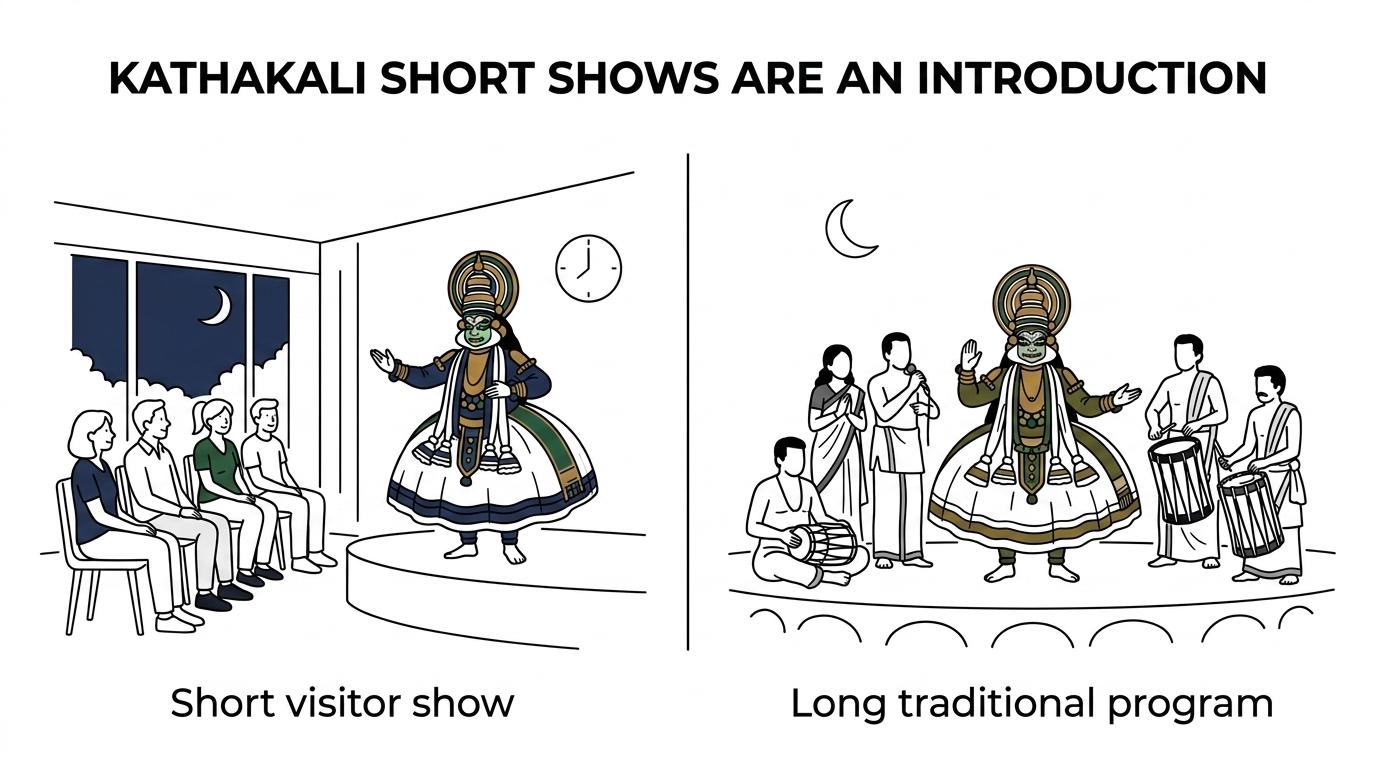
Still, it helps to remember what has been adapted. Traditional Kathakali was designed for long-duration storytelling. In a shorter presentation, you are seeing an accessible version shaped around time, venue logistics, and audience familiarity. That does not make it less worthwhile. It simply means your expectations should be set correctly.
A shorter show is often best if you are balancing sightseeing, transfers, or a limited stay in Kochi. A longer-format program may suit travelers who care deeply about performance traditions and want to experience the art closer to its original rhythm.
Where to watch Kathakali in Kochi and nearby areas
Kochi stands out because it combines cultural visibility, visitor infrastructure, and regular staging. Kerala Tourism repeatedly highlights the Fort Kochi area in Ernakulam as a place where traditional performance forms attract visitors. Official tourism information also notes that KTDC organizes Kathakali and other cultural programs at Bolgatty Palace in Kochi.
That means travelers do not need to guess randomly. If Kathakali is on your Kerala wish list, Kochi is a smart city to prioritize, especially at the beginning or end of a wider Kerala itinerary.
Here is a practical snapshot:
| Area / Venue Type | Why It Matters for Visitors | What You Can Expect |
|---|---|---|
| Fort Kochi cultural venues | One of the best-known places to look for regular Kathakali programs | Evening shows, traveler-friendly timing, easy pairing with heritage walks |
| Ernakulam cultural circuit | Useful if you are staying on the city side and want organized access | Scheduled cultural performances and better transport flexibility |
| Bolgatty Palace area | Officially associated with KTDC cultural staging in Kochi | A more curated setting, often suitable for visitors seeking a polished cultural evening |
| Private hotel or curated venue experiences | Often arranged through tour operators or premium itineraries | Reserved seating, transfers, and in some cases a private Kathakali performance |
Fort Kochi is especially appealing because the experience extends beyond the auditorium. You can spend the afternoon with the colonial-era streets, waterfront views, cafés, churches, and galleries, then move into an evening performance without feeling rushed.
Why Fort Kochi is often the easiest choice
Fort Kochi works well because the area already supports the kind of slow cultural evening that Kathakali deserves. You are not trying to force a performance into a packed city schedule. The neighborhood invites walking, lingering, and a more thoughtful pace.
It is also one of the most commonly packaged cultural stops in Kerala itineraries. Some tour operators include a Kathakali or Ramanattam evening in Fort Kochi, and some premium itineraries even feature a private Kathakali performance. That can be useful for couples, families, or small groups who want more control over timing and comfort.
If your Kerala trip includes only one dedicated arts experience, Fort Kochi is a very strong candidate.
How to watch Kathakali well as a first-time visitor
A good Kathakali experience begins before the curtain rises. Read a short summary of the story if one is available, especially if it includes elements from the Ramayana. Know whether the evening will present a complete episode, selected scenes, or a demonstration format. If the venue offers early access to watch the makeup process, take it.
That preparation changes everything. Once you understand the broad conflict, hero, villain, or emotional turning point, the gestures become much easier to follow.
A few planning choices can make the evening more rewarding:
- Arrive early: Good seating matters because facial expression is central to the performance.
- Ask about format: Some shows focus on highlights, while others are closer to full dramatic episodes.
- Choose the right venue: A smaller hall can offer better visibility for first-time viewers.
- Pair it with Kochi sightseeing: Fort Kochi works especially well for a full cultural day.
- Check language support: Brief English explanations can make the symbolism much clearer.
Once the performance begins, resist the urge to treat it like background entertainment. Kathakali and krishnanattam both open up when you give them your full attention.
What to notice during a Kathakali performance
The first thing many viewers notice is the makeup. In Kathakali, color and facial design are part of character identity, not ornament alone. Even without mastering every code, you can sense that the visual language is deliberate and meaningful.
Next, listen to the relationship between movement and sound. The percussion does not sit behind the action as simple accompaniment. It drives tension, rhythm, and dramatic release. The singers, working within Kerala’s traditional style, support the narrative arc while the actors embody it physically.
Then there is the pacing. Kathakali is comfortable with duration. A moment can expand. A stare can become dramatic action. A pause can feel as charged as a burst of movement. For viewers used to fast editing and constant motion, this can be refreshing.
Short visitor shows versus longer traditional programs
If you are choosing between a compact performance and a more extended presentation, the right answer depends on your interest level and schedule.
A short-format show is ideal when:
- You are new to Kathakali
- You want a cultural evening in Kochi
- You are traveling with children or older family members
- You have an early airport or road transfer the next day
A longer or more traditional program makes sense when:
- You care about performance heritage: The slower build gives the art its full dramatic weight.
- You enjoy classical theatre: Symbolism and repetition become part of the pleasure.
- You can spare the time: The experience is stronger when you are not watching the clock.
Both options have value. What matters is choosing the format that matches your attention, energy, and trip design.
When to include Kathakali in a Kerala itinerary
Kochi is often the gateway city for Kerala, which makes Kathakali easy to place into a larger route. Many travelers arrive in Kochi, spend one or two nights there, and then continue to Munnar, Alleppey, Thekkady, or Kumarakom. In that structure, a Kathakali evening fits naturally.
It also works well at the end of a trip. After beaches, hills, wildlife, or backwaters, a performance night brings a different kind of memory into the mix. Kerala is not only landscape. It is also living tradition, trained discipline, and public artistry.
If you are building a private itinerary, ask for enough space around the evening. Trying to squeeze Kathakali between a late check-in and a long dinner rarely does it justice.
Practical tips for booking a Kathakali evening in Kochi
Most travelers benefit from keeping the plan simple. Pick Kochi. Stay in or near Fort Kochi if possible. Confirm the performance time in advance, and ask whether the venue includes an introduction or makeup viewing. That small amount of planning usually leads to a much richer experience.
A straightforward booking flow often looks like this:
- Spend at least one evening in Kochi.
- Prioritize Fort Kochi if cultural access matters.
- Confirm whether the show is a short presentation, a themed episode, or a longer stage program.
- Arrange transport ahead of time if you are staying outside Fort Kochi.
- Leave enough time after the show instead of scheduling a tight transfer.
Travelers who prefer a more curated experience can also have the evening built into a personalized Kerala itinerary. That is especially useful when combining airport transfers, hotel check-ins, heritage sightseeing, and cultural programming on the same day.
Pairing Kathakali with other Kochi experiences
Kathakali rarely feels isolated in Kochi. It works best as part of a well-shaped day. A morning arrival can be followed by a relaxed lunch, a heritage walk through Fort Kochi, time by the waterfront, and then an evening performance. This pacing gives the art room to breathe.
The city supports that rhythm beautifully. Kochi has the practical advantage of good visitor services and the cultural advantage of being one of the clearest places in Kerala to seek out staged traditional arts. For many travelers, that combination turns a performance booking into something larger: a memorable, well-framed introduction to Kerala’s artistic depth.
If Kathakali is high on your list, plan for it deliberately rather than treating it as an optional add-on. In Kochi, especially around Fort Kochi, doing so is refreshingly achievable.
FAQ on Watching Kathakali
Kathakali is a fascinating dance-drama tradition that provides a deeply immersive cultural experience. Below are some frequently asked questions to guide you in appreciating this mesmerizing performance. expressive dance, vivid costumes, and dynamic facial expressions.
Where can I watch Kathakali in Kochi?
Fort Kochi is a prime location to watch Kathakali, with regular performances at cultural venues and select hotels. costumes, intricate facial expressions, and rhythmic drum patterns.
Can I see the makeup process before the show?
Many venues offer a chance to watch the intricate makeup application, providing further insight into the art form.