Chola Temples Tour Package 4N 5D
A five-day Tamil Nadu heritage journey covering the Great Living Chola Temples, Trichy, Thanjavur, Darasuram, Kumbakonam, Swamimalai and Gangaikonda Cholapuram, with time for temple architecture, Chola bronzes, traditional crafts and historic sites across the Kaveri delta.
Day 1 — Arrive Trichy: Srirangam & Rockfort
Airport transfer: 20 minutes · Overnight: Trichy
We collect you at Tiruchirappalli airport, railway station or hotel. Trichy is central enough that most people reach it easily by train from Chennai or Madurai.
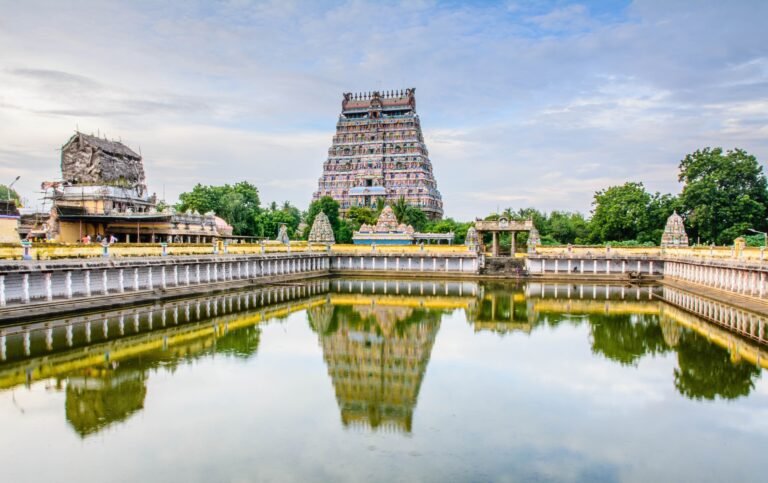
Srirangam in the late afternoon, which is when the light is best and the heat has gone off the stone. The Ranganathaswamy temple covers 156 acres inside seven concentric walls, and the outer enclosures are a living town — shops, houses, people going about their day. You walk inward through the gopurams, and each wall takes you further from the traffic and closer to silence. The Rajagopuram at the southern entrance is 72 metres and among the tallest temple towers in Asia.
Then the Rockfort at sunset — 437 steps cut into an 83-million-year-old outcrop in the middle of the city, with the Ucchi Pillayar temple at the top and a view over the Kaveri, Srirangam and the whole plain. The climb is steep but the steps are wide and shallow, and it takes most people twenty-five minutes at an unhurried pace.
Day 2 — Trichy to Thanjavur & Brihadeeswarar Temple
Drive: about 1.5 hours · 60 km · Overnight: Thanjavur
An easy morning drive east along the Kaveri delta. You check into your hotel in Thanjavur and stay there for the rest of the trip.
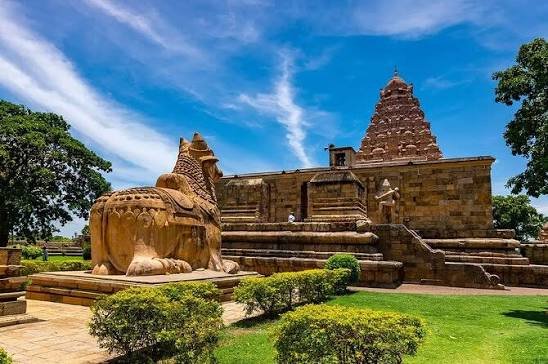
The Brihadeeswarar temple, or Big Temple, was finished in 1010 AD by Rajaraja Chola and it is still the single most impressive building in South India. The vimana above the sanctum rises 66 metres and is topped by a single granite block weighing around 80 tonnes — how it was raised is still argued about. The Nandi in the courtyard is carved from one stone, six metres long. The inscriptions running around the base are a complete administrative record of the temple’s endowments, which is why historians care about it as much as architects do.
Allow two to three hours, and go late in the afternoon when the granite turns gold and the courtyard fills with people rather than tour groups.
In the morning or the following day, the Thanjavur Maratha Palace — a rambling complex with the Durbar Hall, the bell tower, an art gallery holding some of the finest Chola bronzes anywhere, and the Saraswathi Mahal Library, one of the oldest working libraries in Asia with about 49,000 palm-leaf and paper manuscripts.
Day 3 — Darasuram, Kumbakonam & Swamimalai Bronze Casting
Day trip: about 40 km each way · Overnight: Thanjavur
An hour north-east to Darasuram and the Airavatesvara temple, the second of the three UNESCO Chola sites and the one most people have never heard of. It is smaller than Thanjavur and far more finely carved — the front mandapam is built as a stone chariot drawn by horses, and there is a flight of steps that produces different musical notes when struck, which the guides will demonstrate and which is genuinely surprising. It is usually almost empty.
Then Kumbakonam, a temple town of around twenty temples in a few square kilometres, built around the Mahamaham tank where a bathing festival draws millions once every twelve years. The Sarangapani and Kumbeshwarar temples are the two to see if you want two rather than twenty.
In the afternoon, Swamimalai — a village where bronze icons have been cast by the same families for about a thousand years, using the lost-wax method the Cholas used. A wax model is made, coated in delta clay, fired so the wax runs out, and filled with molten bronze. The mould is broken to release the icon, so every piece is unique. Swamimalai bronzes carry a Geographical Indication tag, and watching the process is the most memorable half hour of this trip for a great many people.
Day 4 — Gangaikonda Cholapuram Chola Temple Day Trip
Day trip: about 75 km each way · Overnight: Thanjavur
An hour and a half north to the third UNESCO site, and the reason to take this itinerary rather than a standard temple circuit.
After Rajendra Chola’s campaign north to the Ganges around 1023 AD he built a new capital and named it “the town of the Chola who took the Ganges”. The city is gone — there is farmland where it stood — but the temple remains, with a vimana of 55 metres, a Nandi, and carving that many art historians consider finer than Thanjavur’s even if the scale is smaller.
You will very likely have it almost to yourself. There is no queue, no crowd and very little infrastructure, and that is exactly the point.
Back to Thanjavur in the afternoon. If you have energy, the Thanjavur art gallery in the palace complex holds a collection of Chola bronzes worth an hour on its own, and the town is known for Tanjore painting — gold leaf on board, made here since the Maratha period, and sold in workshops where you can watch it being done.
Day 5 — Thanjavur to Trichy Departure
Drive: about 1.5 hours · 60 km
A slow morning, then back west to Tiruchirappalli for your flight or train. Allow three hours before a domestic departure.
If your train or flight is late in the day, we can add the Thiruvanaikaval temple near Srirangam on the way — one of the five Pancha Bhoota Sthalams, representing the element of water, with a spring in the inner sanctum that never dries.
Frequently Asked Questions – Chola Temples Tour Package
What Are the Great Living Chola Temples?
They are a single UNESCO World Heritage property made up of three temples built by the Chola dynasty: Brihadeeswarar at Thanjavur (1010 AD), Gangaikonda Cholapuram (around 1035 AD) and Airavatesvara at Darasuram (12th century). Thanjavur was inscribed in 1987 and the other two were added in 2004.
“Living” is the operative word — all three are still active places of worship rather than ruins or museums, which is unusual for a heritage site of this age. This itinerary covers all three. Most Tamil Nadu tours cover only Thanjavur.
Can Non-Hindus Visit the Chola Temples?
At the three Chola temples, yes — they are open to everyone including the sanctum areas, and photography is permitted in the outer courtyards.
Srirangam is different. Visitors of all faiths are welcome into most of the seven enclosures, but the innermost prakaram around the main sanctum is restricted to Hindus. That still leaves the overwhelming majority of a 156-acre complex open to you, and the walk inward through the gopurams is the experience regardless. Dress modestly at all four sites — shoulders and knees covered — and expect to remove shoes at the entrances.
Is This Chola Temples Tour Only for Temple Lovers?
It helps, but the appeal is broader than devotion. These are among the most significant works of architecture and engineering in medieval Asia, and the interest is in how they were built as much as why. The 80-tonne capstone at Thanjavur, the musical steps at Darasuram, and the inscriptions that record a complete eleventh-century administration are the sort of thing that holds people who would not describe themselves as temple travellers.
The bronze casting at Swamimalai and the Saraswathi Mahal manuscripts widen it further. If your party has one person enthusiastic about this and one who is not, five days is about right — much longer and the second person will have had enough.
How Much Walking Is Involved in the Chola Temples Tour?
A moderate amount, and mostly on stone, barefoot inside the temple compounds. Brihadeeswarar and Gangaikonda Cholapuram both have large open courtyards that get genuinely hot underfoot by midday, which is why we schedule them for the late afternoon.
The Rockfort at Trichy is the only real climb — 437 steps, wide and shallow, about twenty-five minutes up. It is entirely optional and the Srirangam visit stands on its own without it. Carry socks if hot stone is a problem; a good many visitors do.
What Is the Best Time for a Chola Temples Tour?
November to February. The Kaveri delta is flat and open with very little shade, and from March onwards it becomes hard work — April and May regularly exceed 38°C and the temple courtyards are unshaded granite.
October to December brings the northeast monsoon, which affects this region less severely than the coast but can still produce heavy afternoon rain. July to September is dry and workable if you accept the heat. If you are choosing between months, January is the best of them.
What Other Places Can We Add to This Chola Temple Tour?
A great deal, and the delta is compact.
Chettinad
is about two hours south of Thanjavur — merchant mansions of Burmese teak and Italian marble, and the most distinctive food in the south.
Velankanni, Nagore and Tranquebar
sit on the coast east of Kumbakonam and give you a Catholic basilica, a Sufi dargah and a Danish fort within forty kilometres of each other, which is the delta in miniature.
For something entirely different, the
Muthupet mangroves
are where the Kaveri finally reaches the sea, about two hours from Thanjavur. Any of these adds two to four nights without backtracking.
Can This Chola Temples Tour Be Combined with the Rest of Tamil Nadu?
Easily. Trichy sits almost exactly in the middle of the state, so this route joins onto anything. Madurai is two and a half hours south-west, Chennai five hours north-east, and the Nilgiris four hours west.
The most natural longer version is our
10-day Sacred South India tour
,
which takes the temple corridor at a broader sweep. If you want the Chola sites specifically covered in depth rather than passed through, take this itinerary and let us bolt the rest on around it — tell us at enquiry and we will build it as one route with a single vehicle and driver.
Why Stay in Thanjavur for Three Nights Instead of Changing Hotels?
Because everything is within ninety minutes of it. Darasuram is an hour, Kumbakonam an hour, Swamimalai fifty minutes, Gangaikonda Cholapuram an hour and a half. Moving hotels would save no driving at all and would cost you two mornings to packing and checking in.
It also means you see Brihadeeswarar more than once. Most people go back in the evening of their own accord, and it is a different building at six o’clock than it is at two.