Kerala is often introduced through backwaters, hill stations, beaches, and Ayurveda. Yet in North Malabar, another experience changes the mood entirely. Theyyam belongs to a different rhythm of travel, one shaped by shrine calendars, village memory, percussion, fire, and devotion.
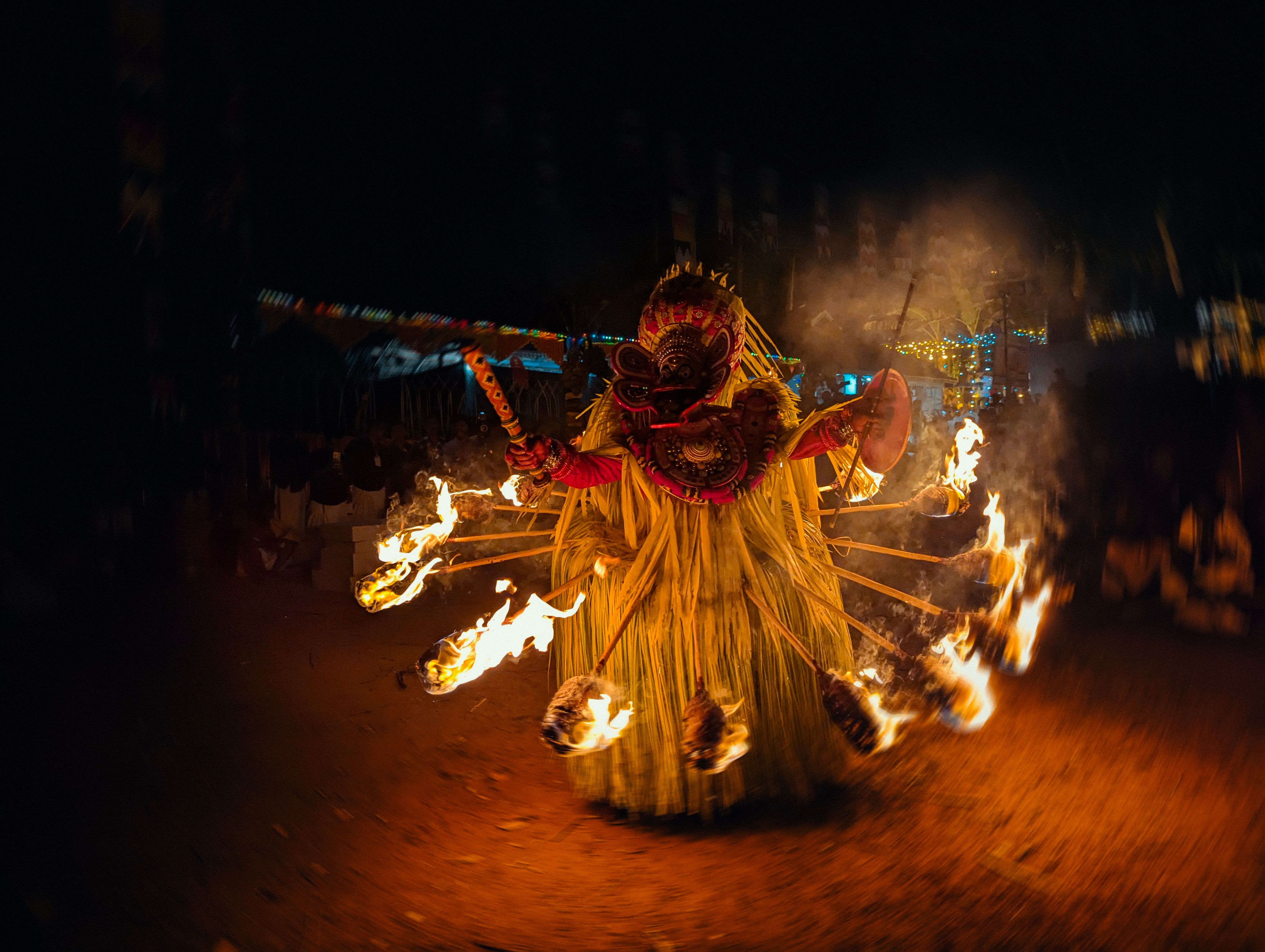
For many first-time visitors, the immediate impression is visual. Towering headgear. Bold facial designs. Intense red, black, and white. Drums that seem to move through the ground as much as through the air. Still, the deeper meaning of Theyyam is not in spectacle alone.
 Official tourism sources consistently describe Theyyam as a ritual art form of northern Kerala, especially Kannur and Kasaragod. That phrasing matters. Theyyam is not simply a dance to be watched. It is ritual theatre in a sacred setting, where the performer is received with reverence and the community participates in something older, larger, and still very much alive.
Why Theyyam is ritual theatre, not a stage show
To attend Theyyam well, begin with one clear idea: this is worship first, performance second.
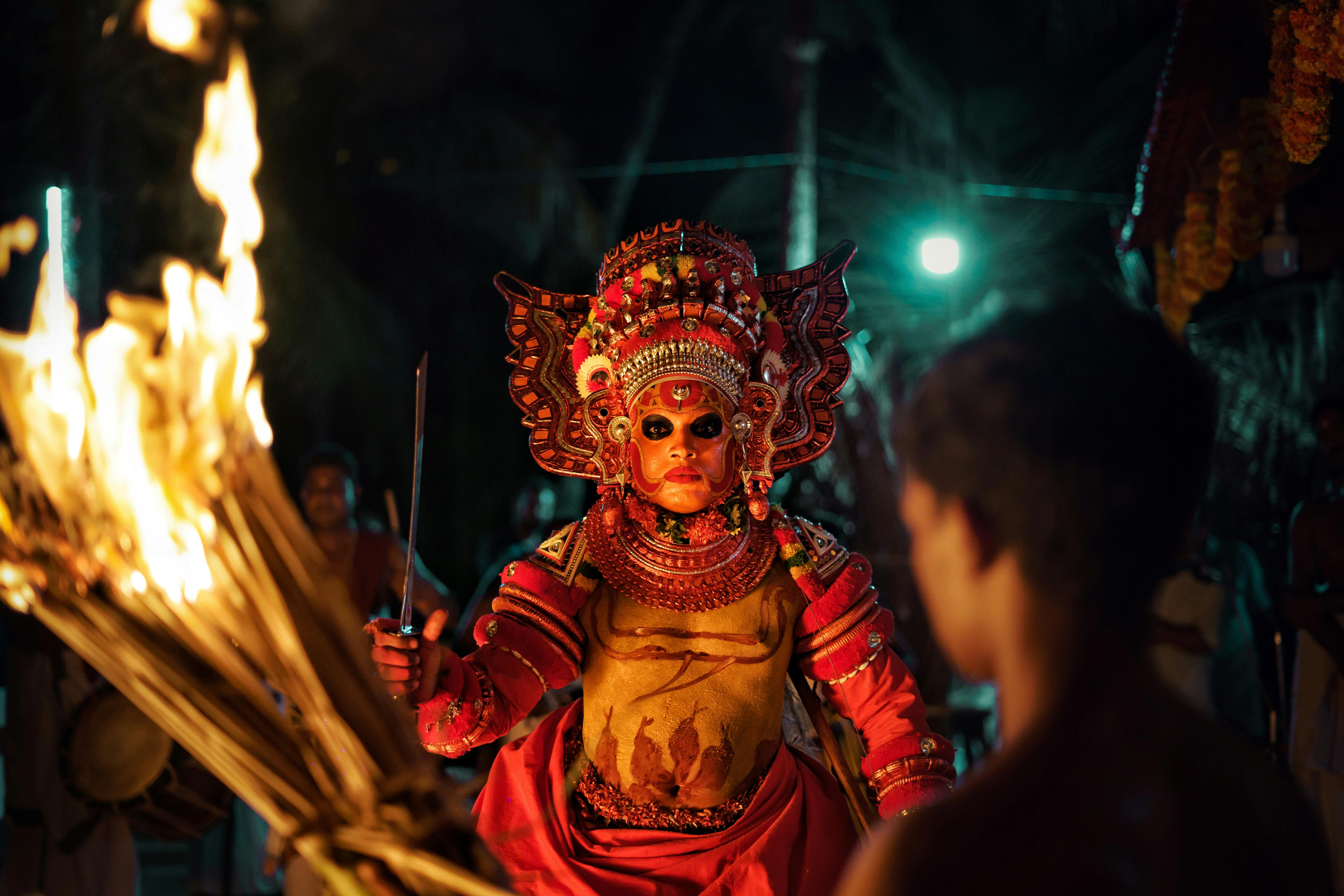
That single distinction changes how you see everything around it. The makeup is not just aesthetic design. The theyyam costume is not just costume. The music is not background. Each element belongs to a ritual process through which a performer becomes the visible presence of a deity, ancestral force, or guardian spirit within the ceremony.
Theyyam is a particularly striking example of such performances, mainly found in the North Malabar region of Kerala, India. This ritual form combines dance, music, and elaborate costumes, creating a powerful spectacle that blurs the lines between performance and divine invocation. Participants in Theyyam are believed to embody deities and ancestral spirits, thereby serving an essential role in maintaining the cultural and spiritual fabric of their communities.
This is one reason Theyyam leaves such a strong impression on serious cultural travelers. It combines theatre, music, oral tradition, movement, shrine worship, and community memory in one living form. Many traditions can be relocated to auditoriums. Theyyam remains most powerful in its own setting.
What Theyyam means in North Kerala
North Kerala, often called North Malabar in this context, is the heartland of Theyyam. Official sources place its strongest presence in Kannur and Kasaragod, while also noting performances in parts of Wayanad and northern Kozhikode. Some related traditions appear across the border as well, including those of the Vannan community, but the cultural center of gravity remains firmly in this northern Kerala belt.
That regional rootedness is part of Theyyam’s character. The performance is tied to local shrines, temple compounds, and sacred groves known as kavus. A traveler does not simply “go to a show.” One goes to a place where ritual continuity has been maintained through generations.
The result is a rare kind of cultural encounter. You are not looking at a reconstructed past. You are standing inside a practice that communities still honor in the present.
Where to see Theyyam in North Malabar
If you are planning a Kerala trip around Theyyam, the location matters as much as the date. Some areas are especially associated with the tradition, and each setting offers a slightly different atmosphere.
| Area | Why it matters for Theyyam | What travelers can expect |
|---|---|---|
| Kannur | One of the best-known centers of Theyyam | Strong seasonal activity, many shrine-based performances, deep local familiarity |
| Kasaragod | Another core district in the Theyyam belt | Ritual settings with strong regional character and seasonal gatherings |
| Northern Kozhikode | Part of the wider cultural spread | Fewer options than Kannur, but still relevant in the broader map |
| Wayanad | Included in the wider North Malabar context | Select performances connected to local tradition |
| Kavus and temple precincts | The classic ritual setting | A sacred atmosphere rather than a formal audience arrangement |
Kannur is often the most practical base for visitors because of its strong association with Theyyam and better trip-planning convenience. Kasaragod is equally significant for travelers who want a more focused cultural route across North Malabar. In both districts, local scheduling knowledge is valuable because performance dates and venues can shift by shrine calendar and custom.
For travelers building a wider Kerala holiday, Theyyam can pair well with Kannur’s beaches, Thalassery’s heritage character, Bekal’s coastal scenery, or a longer North Kerala circuit that includes Wayanad. A custom itinerary is especially useful here, since Theyyam timing rarely fits a standard sightseeing template.
How a Theyyam performance unfolds
The full experience begins long before the most dramatic moment. Preparation itself is part of the event. Makeup, costume assembly, rhythmic chanting, percussion, and anticipation all build toward transformation. Even for seasoned travelers, it can feel less like the opening of a performance and more like the gradual charging of a sacred space.
Theyyam is an intrinsic part of Kerala’s cultural fabric, a ritual dance form that transforms individuals into deities. Participants in a theyyam performance undergo a rigorous process of transformation through intricate costumes and makeup, becoming vessels for divine spirits. Each gesture and costume element in theyyam carries a deeper significance, drawing audiences into a realm where the mundane and the mystical intersect.
In local conversation, you may hear the word thottam, or even reference to the Vannan community which often plays a significant role in Theyyam performances. This refers to an invocatory segment associated with the ritual sequence, often involving sung narration connected to the deity or figure being honored. Later comes the more visually powerful appearance, when costume, makeup, and headgear bring the form fully into view.
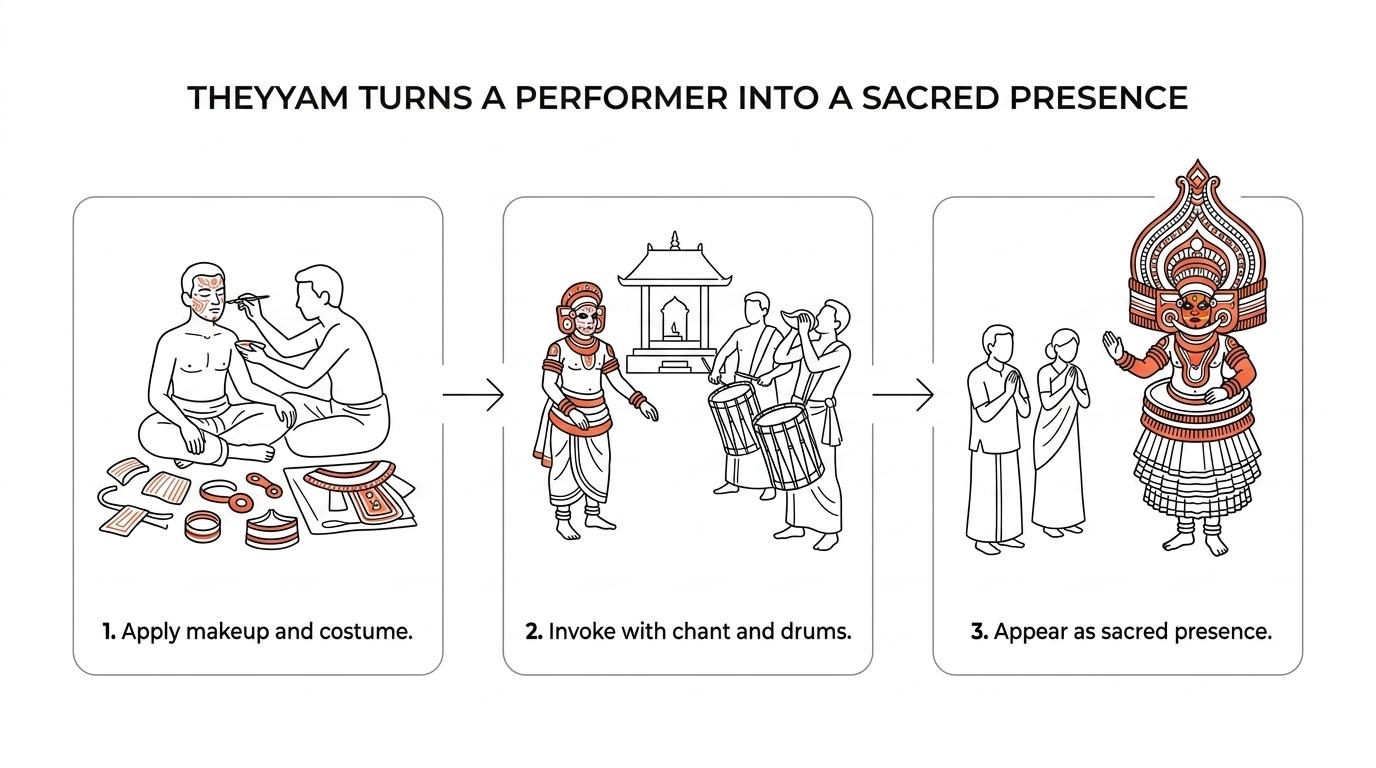
Music shapes the atmosphere throughout. Kerala Tourism sources mention traditional instruments including drums, conches, and utukku. Their role is not decorative. They set rhythm, intensity, and ceremonial force.
A few elements often stand out to first-time viewers:
- Vivid facial painting
- Layered skirts and body adornment
- Towering mudi or headgear
- Drums, conch sounds, and utukku
- Firelit movement and circular energy
Costume, makeup, and sacred presence
The visual design of Theyyam is among the most striking in India’s ritual arts. The face becomes a surface of iconography. Lines, color fields, symmetry, and contrast are used with great precision. Red often dominates, though palettes vary by form and local tradition.
The mudi, or headgear, deserves special attention. It changes the scale of the performer and contributes to the sense of transformation. Seen from a distance, the figure appears larger than human. Seen up close, the craftsmanship becomes just as impressive as the dramatic impact.
Yet the right response to theyyam is not only admiration for artistry. Within the ritual frame, the dressed performer is approached with devotion. People may seek blessings, offer prayers, or stand with a seriousness that makes the setting very different from a folk festival or cultural fair.
When to plan a Theyyam trip in Kerala
Timing matters. Official tourism and cultural sources usually place the main Theyyam season between December and April, with some performances extending into May. This seasonal rhythm makes winter and early summer especially rewarding for travelers whose main goal is cultural experience in North Kerala.
Schedules are not uniform. One shrine may host its Theyyam on dates different from another village just a short distance away. That is why advance planning pays off, especially for international travelers or families working with fixed arrival dates.
A few practical points help:
- Season: Most performances take place from December to April, with some continuing into May.
- Timing: Events may happen late at night, before dawn, or in the early morning.
- Setting: Many take place in kavus or temple precincts, not conventional auditoriums.
- Planning: Exact dates should be checked locally rather than assumed from general travel calendars.
- The Theyyam ritual is a spectacular display of music, dance, and vibrant costumes, unique to the northern parts of Kerala. Attendees witness performers transforming into deities, showcasing both intense devotion and a deep connection to the region’s cultural heritage. Observing Theyyam can offer profound insights into the local community’s spiritual life.
This seasonal window also pairs beautifully with wider travel across Kerala. The weather is often favorable for combining Theyyam with the coast, backwaters, plantations, or a longer South India route through Kerala and Tamil Nadu.
Which is the most powerful Theyyam?
Among the hundreds of Theyyam forms, Muchilottu Bhagavathi, Vishnumoorthy Theyyam, and Gulikan Theyyam are often regarded as the most powerful and revered. Each Theyyam embodies a unique deity or ancestral spirit, but Vishnumoorthy Theyyam is especially renowned for its intense energy, elaborate rituals, and the large crowds it attracts. The power of a Theyyam is not only in its visual grandeur but in the deep spiritual connection it fosters within the community, often believed to bring blessings, protection, and guidance.
Why does Theyyam have red color?
Red is the most dominant color in Theyyam for both symbolic and ritual reasons. In Kerala’s ritual tradition, red represents divine energy, power, and protection. It is associated with the goddess, fire, and the transformative force of the ritual itself. The vivid red face paint, costumes, and decorations are believed to invoke the presence of the deity and ward off negative influences. The color also heightens the visual impact of the performance, making the transformation of the performer into a living deity unmistakable to all present.
How to attend Theyyam respectfully
A respectful visit begins with observation. Watch how local devotees position themselves, when they move closer, and when they keep distance. Sacred spaces have their own etiquette, and quiet attention usually teaches more than rushed photography ever will.
Dress modestly. Arrive early. Accept that waiting is part of the experience. A Theyyam event may not follow the punctual structure expected in urban performance venues, and that is part of its integrity rather than a flaw in organization.
Photography requires sensitivity. In some settings it is welcomed, in others it may be limited or discouraged at certain moments. Ask when possible, follow local cues, and avoid turning the ritual into a personal content-gathering exercise. The strongest memory often comes from being present, not from collecting hundreds of images.
Travelers with children can absolutely attend, though timing should be chosen carefully. Late-night ceremonies may be challenging for younger visitors. Couples and solo travelers often find early morning events easier to absorb at a calmer pace.
Why Theyyam matters for Kerala cultural travel
Many visitors arrive in Kerala with a strong image of landscape. They leave North Malabar with a stronger sense of living culture. Theyyam adds depth to the state’s travel identity because it cannot be reduced to scenery. It asks for attention, context, and a willingness to be present in a community setting.
That is exactly why it matters.
A well-planned Theyyam visit can reshape an itinerary from pleasant to memorable. Instead of moving only between hotels and viewpoints, travelers step into a ritual tradition that official sources often describe as centuries old and central to the heritage of North Malabar. For those seeking meaning as well as beauty, that difference is substantial.
Planning a Kerala itinerary around Theyyam
The most rewarding approach is usually to treat Theyyam as the anchor of a few days in North Malabar, rather than a quick stop added at the last minute. A base in Kannur or Kasaragod gives room for flexible timing, early departures, and visits to multiple shrines if the calendar allows. Private transfers are especially helpful because many venues are outside the pattern of standard tourist movement.
A broader itinerary can still remain balanced. North Kerala cultural travel pairs naturally with quieter beach stays, heritage walks, local cuisine, and onward travel into central Kerala or Tamil Nadu. Travelers who prefer comfort and structure often benefit from a tailor-made plan with date checks, accommodation selection, and on-ground support arranged in advance.
For anyone looking beyond the usual postcard version of Kerala, Theyyam offers something rarer: a direct encounter with place, season, ritual, vannan tradition, and living memory, all meeting in the firelit space of North Malabar.
Theyyam, a captivating ritual theater deeply rooted in North Kerala’s traditions, offers travelers an immersive cultural experience by intertwining sacred rituals with vibrant visual elements and haunting traditional music. Against the backdrop of Kannur and Kasaragod, Theyyam transcends mere performance, inviting visitors into a centuries-old spiritual practice that is both a living testament to regional identity and a profound expression of devotion. Planning a journey centered around Theyyam not only enriches one’s understanding of Kerala’s rich cultural tapestry but transforms an ordinary itinerary into an unforgettable exploration of authenticity and community.
Theyyam, an enthralling synthesis of spirituality and theater, captivates audiences with its dazzling displays of divine impersonation.
Theyyam FAQ
Theyyam, a vibrant form of ritual theatre in North Kerala, offers travelers an unforgettable cultural experience. This mystical art form transforms its performers into divine entities in sacred settings.
What is Theyyam?
Theyyam is a ritual art form from North Kerala that combines dance, music, and elaborate costumes to embody deities and ancestral spirits.
Where is Theyyam performed?
Theyyam is prominently performed in North Malabar, with Kannur and Kasaragod being the central locations, also extending into parts of Wayanad and northern Kozhikode.
When is the best time to see Theyyam?
The primary season for Theyyam is between December and April, with some performances occurring into May.
Can visitors attend Theyyam performances?
Yes, travelers can attend Theyyam, but it’s important to do so respectfully, observing local customs and etiquette.
How should I prepare for a Theyyam visit?
Dress modestly, arrive early, and be prepared for events to occur in sacred spaces rather than conventional venues.
What makes Theyyam unique?
Theyyam is unique for its spiritual dimension where performers become vessels for divine spirits, set apart by its vivid costumes, facial paintings, and cultural depth.
Is photography allowed at Theyyam events?
Photography may be allowed, but it’s best to ask permission and follow local cues to respect the sacredness of the event.