Many people hear the word panchakarma and picture warm oil, gentle massage, and a few quiet days at an Ayurvedic retreat. That image captures only a small part of the rejuvenation and therapeutic picture.
A real panchakarma program is far more structured, offering a comprehensive detoxification process. In classical Ayurveda, it refers to a set of cleansing and treatment procedures delivered in phases, usually with medical supervision, a controlled diet, and careful follow-up. Recent reviews describe it as a sequence of preparatory and eliminative interventions rather than a single therapy, while the NCCIH places it within Ayurveda’s wider system of diet, lifestyle, products, and physical practices.
Panchakarma in Ayurveda is not a single spa treatment
Ayurveda is a traditional Indian medical system rooted in the wisdom of nature, with many components, including the balancing of doshas such as vata, pitta, and kapha. Panchakarma is one therapeutic subset within that system, not a synonym for Ayurveda itself. That distinction matters, because it changes what a person should expect from a serious program.
In practice, panchakarma is usually planned as a course of care that often incorporates elements such as meditation to enhance overall well-being. A physician or qualified Ayurveda practitioner first assesses the person, their symptoms, their strength, their digestion, and their readiness for therapy. Only after that comes the treatment design. This is one reason a two-hour “panchakarma package” at a hotel spa should be viewed very differently from a residential clinical program.
Current literature also makes another point clear: there is variation. Clinics may follow classical texts closely, or they may adapt the process to modern facilities, patient needs, and physician judgment. Reviews note that standardization is still limited, which means quality can differ widely from one center to another.
Panchakarma program phases and timeline
The simplest way to think about panchakarma is as a three-part process: preparation, the main body cleansing procedure or procedures, and post-therapy recovery.
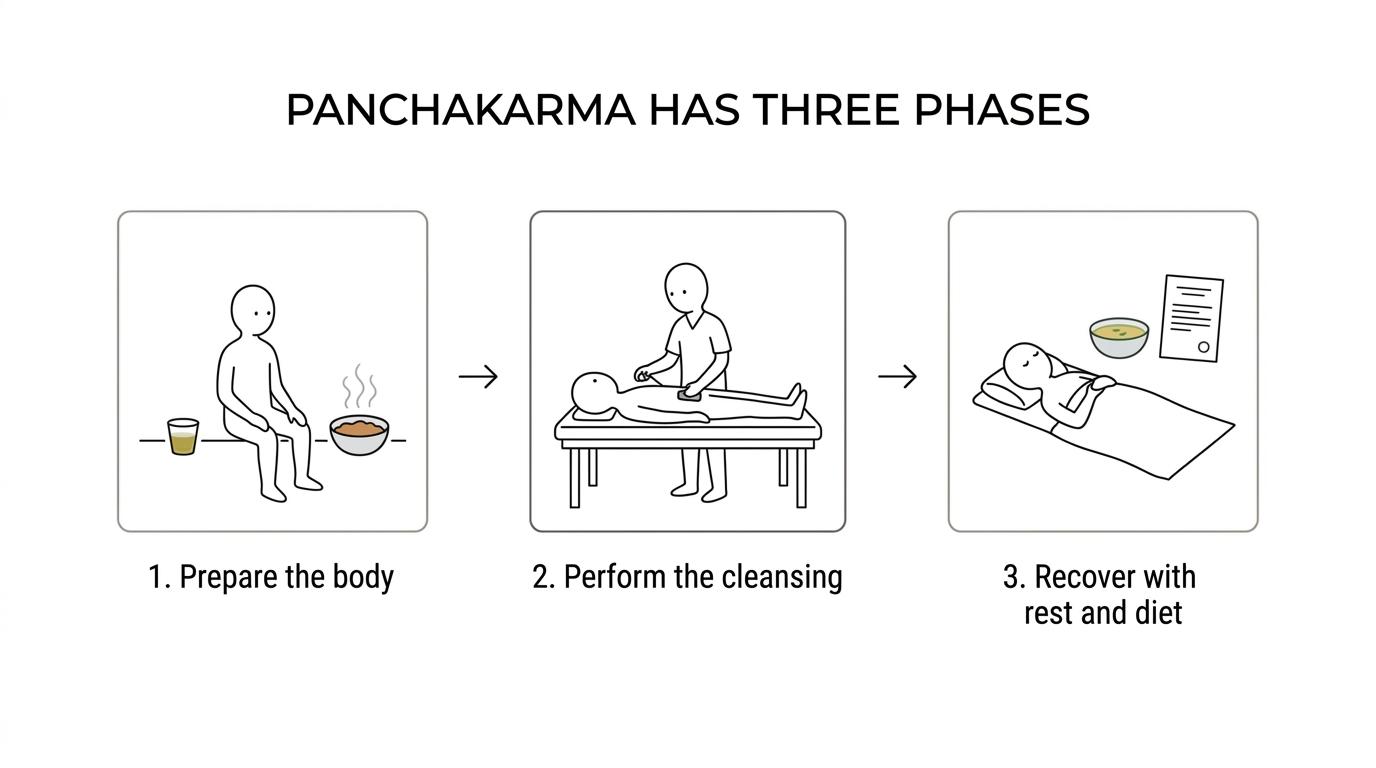
That structure is one of the clearest signs that a program is real. A clinic that talks only about the “main detox” without describing preparation and aftercare is leaving out core parts of the process.
| Phase | What it often includes | Why it matters |
|---|---|---|
| Initial assessment | Medical history, Ayurvedic assessment, treatment planning, diet review | Determines whether panchakarma is appropriate and which procedure is selected |
| Preparation phase | Deepana, pachana, internal oleation, external oil therapies, svedana, dietary regulation | Gets the body ready for the main intervention |
| Main procedure phase | One or more classical procedures, selected case by case | This is the active cleansing component |
| Recovery phase | Rest, monitoring, graduated diet, restrictions, supportive medicines | Helps the body stabilize after the procedure |
A real program is not always built around all five classical procedures. In many cases, the physician may choose one primary therapy, or a limited combination, based on the person’s condition and capacity. That is often a mark of thoughtful planning rather than a reduced service.
Program length varies. Shorter supervised plans may run a week or a little more, while fuller residential programs can extend well beyond that. Some protocols in published literature describe several days of preparation alone before the main therapy begins.
Panchakarma preparation phase: deepana, oleation, and svedana
Preparation is often called purva karma. This phase is not decorative. It is considered functional and central to the treatment.
Published protocol papers describe preparatory steps that may begin with deepana and pachana, ayurvedic terms commonly used for measures intended to stimulate digestive function and process metabolic residue before stronger therapies are attempted. After that, many programs use internal oleation with medicated ghee or oils over several days, followed by external therapies and sweating procedures.
A serious center usually pays close attention to food during this phase. Meals are often simple, warm, light, and timed consistently. Alcohol, very heavy foods, erratic sleep, and intense activity are commonly restricted. The point is to reduce strain and create favorable conditions for the main therapy.
Massage can be part of this phase, but it should not be mistaken for the whole treatment. In panchakarma, oil application and bodywork are often supportive procedures linked to a larger clinical aim.
After a proper intake discussion, the preparation stage often includes:
- diet regulation for detoxification
- internal oleation
- external oil application
- steam or sweating therapy
- observation of response
- schedule adjustments
When people say, “I did panchakarma for three days,” the real question is what those three days actually contained. Without preparation, the label can be misleading.
Panchakarma main procedures: Vamana, Virechana, Basti, Nasya, and Raktamokshana
Classical texts describe five core procedures, and recent academic reviews repeat the same broad list: Vamana, Virechana, Basti, Nasya, and Raktamokshana. Not every modern program offers every procedure, and not every procedure is suitable for every guest.
Vamana refers to therapeutic emesis in selected situations and under strict supervision. Virechana refers to therapeutic purgation. Basti includes medicated enema therapies, often considered a major branch within panchakarma. Nasya involves the administration of medicines through the nasal route. Raktamokshana is bloodletting, though it is less commonly part of wellness-oriented residential programs.
This is one area where the gap between spa marketing and clinical reality becomes obvious. These are not casual add-ons. They are procedures with indications, contraindications, timing rules, preparation requirements, and recovery needs.
A thoughtful practitioner will usually explain not just what is being planned, but why it is being selected. That discussion matters because panchakarma is not intended to be a menu of attractive treatments chosen only by preference.
Signs that the main therapy is being handled seriously often include the following:
- Selection: one or two procedures may be recommended instead of “all five”
- Supervision: the main therapy is physician-led, not simply therapist-led
- Monitoring: appetite, bowel pattern, sleep, strength, and tolerance are checked
- Adjustment: dosage, timing, and even the treatment plan can change based on response
That last point is especially important. A real program adapts to the person. It is structured, but it is not rigid.
Panchakarma recovery phase: diet, rest, and observation
The recovery period after the main procedure is often underestimated by first-time visitors. Yet in classical practice, post-therapy care is part of the treatment itself, not an optional add-on.
Diet is usually rebuilt gradually, considering the balance required for the kapha dosha. After strong cleansing procedures, the digestive system may be treated as temporarily delicate, so foods move from lighter preparations toward a more normal pattern over time. Rest, rejuvenation, and meditation are also emphasized. Long road trips, hectic sightseeing schedules, and late nights are not ideal right after major procedures.
This is one reason panchakarma works best when travelers avoid overpacking their itinerary. A program that places a wildlife safari, a mountain transfer, and a late check-in on the day after a key procedure is not respecting the logic of the treatment.
A realistic recovery phase may include:
- light meals for a few days to balance kapha
- quiet routines
- limited physical exertion
- review consultations
- supportive herbal medicines
- instructions for the return home
For wellness travelers in Kerala, this has a practical side. If panchakarma is the main purpose of the trip, it often deserves its own dedicated stay rather than being squeezed between busy sightseeing segments.
Panchakarma safety, evidence, and standardization
Panchakarma carries a strong traditional framework, but modern evidence remains limited. The NCCIH notes that scientific evidence for Ayurveda across many health conditions is still sparse, and many clinical trials have been small or not well designed. That does not erase long-standing use, but it does mean claims should stay measured.
There is also a quality issue. Contemporary reviews point out that published modern practice guidelines for panchakarma remain limited or are still being developed. That means one center’s protocols, staffing, hygiene, documentation, and follow-up may look very different from another’s.
The World Health Organization has published benchmark documents for Ayurveda practice that cover infrastructure, facilities, health interventions, products, devices, and ethical and regulatory matters. Those benchmarks are helpful because they frame safety and quality as operational matters, not just philosophical ones.
For a guest or traveler, the practical lesson is simple: authenticity is not only about décor, Sanskrit terminology, or heritage branding. It is also about clinical judgment, facility standards, product quality, informed consent, and the willingness to say no when a procedure is not appropriate.
Choosing a Kerala panchakarma center for a residential stay
Kerala is one of the best-known destinations for Ayurvedic residential care, and many travelers arrive expecting both healing traditions and hospitality. That can be a strong combination when the clinical side remains solid.
A well-run stay usually feels calm, organized, and intentional. The medical consultation is not rushed. Meals are coordinated with treatment. Therapists are trained for the specific procedures they perform. Transportation if needed, is timed sensibly so the guest is not pushed through demanding travel during sensitive treatment days.
This is where travel planning matters more than many people expect. A beautifully designed South India holiday can still support panchakarma, but only if the treatment block is protected from constant movement. Choosing verified accommodation, reliable transfers, and a schedule with room for observation can make the whole experience more coherent.
Before booking, it helps to ask direct questions instead of relying on brochure language.
- Who evaluates the guest: an Ayurveda physician, therapist, or front-desk coordinator?
- What does the program include: assessment, preparation, main procedure, and post-therapy care?
- How long is the stay: enough time for preparation and recovery, or mainly a wellness sampling?
- What is monitored: diet, response, contraindications, and daily review?
- What standards are followed: hygiene, product sourcing, documentation, and escalation if a problem arises?
- What happens after discharge: written instructions, medicines, and follow-up guidance?
Good answers tend to be calm, specific, and transparent.
That is often the clearest sign that the program is built as treatment first, hospitality second, even when the setting is peaceful, comfortable, and beautifully managed.