Kochi’s past is often summarized with a few familiar images: spice warehouses, harbor winds, colonial facades, and Chinese fishing nets. Yet the city’s trading story becomes far more vivid in Mattancherry, where streets, faith, commerce, and royal history still sit close together.
That is why Mattancherry, Jew Town, and the old trade network of Kochi make the most sense when seen as one connected heritage district rather than as separate sightseeing stops. In a short stretch of road, you move from a royal palace to a historic Jewish quarter, from spice godowns to antique-lined lanes, and from memory to living commerce.
A visit here rewards a slower pace.
Kochi trading history after the 1341 flood
Kochi did not rise in isolation. Its importance is closely tied to the decline of Muziris, the great ancient port near present-day Kodungallur. Official district sources note that Kochi gained significance as a trading center after the Periyar flood of 1341 damaged Muziris and shifted the commercial geography of the Malabar Coast.
That turning point matters because it explains why Kochi later became such a strong maritime hub. With a more favorable harbor and direct access to inland spice-producing regions, the city grew into one of the key ports in the Indian Ocean trade network. Pepper, ginger, cardamom, cinnamon, and other goods moved outward from Kerala, while merchants, sailors, and communities from many parts of the world moved inward.
Historical references to Kochi connect it with Greeks, Romans, Jews, Syrians, Arabs, and Chinese traders. This was not a closed port serving one empire at a time. It was a meeting ground shaped by layered contact over centuries.
Kerala’s wider Spice Route story gives this even more scale. Kerala Tourism describes the Spice Route as one of history’s great trade corridors, linking the East and West, with trade relations stretching across dozens of countries. Kochi’s place within that network was not accidental. Geography, river systems, monsoon winds, and demand for spices all came together here.
Mattancherry and Jew Town as one heritage zone
Many visitors first hear about Mattancherry Palace, Jew Town, and the Paradesi Synagogue as separate names on a day tour. On the ground, they are tightly linked.
According to Kerala Tourism, Jew Town, also known as Jew Street, lies between Mattancherry Palace and the Paradesi Synagogue. That physical placement says a lot. Royal authority, mercantile life, and a settled Jewish community were not distant chapters of Kochi’s history. They existed in close contact.
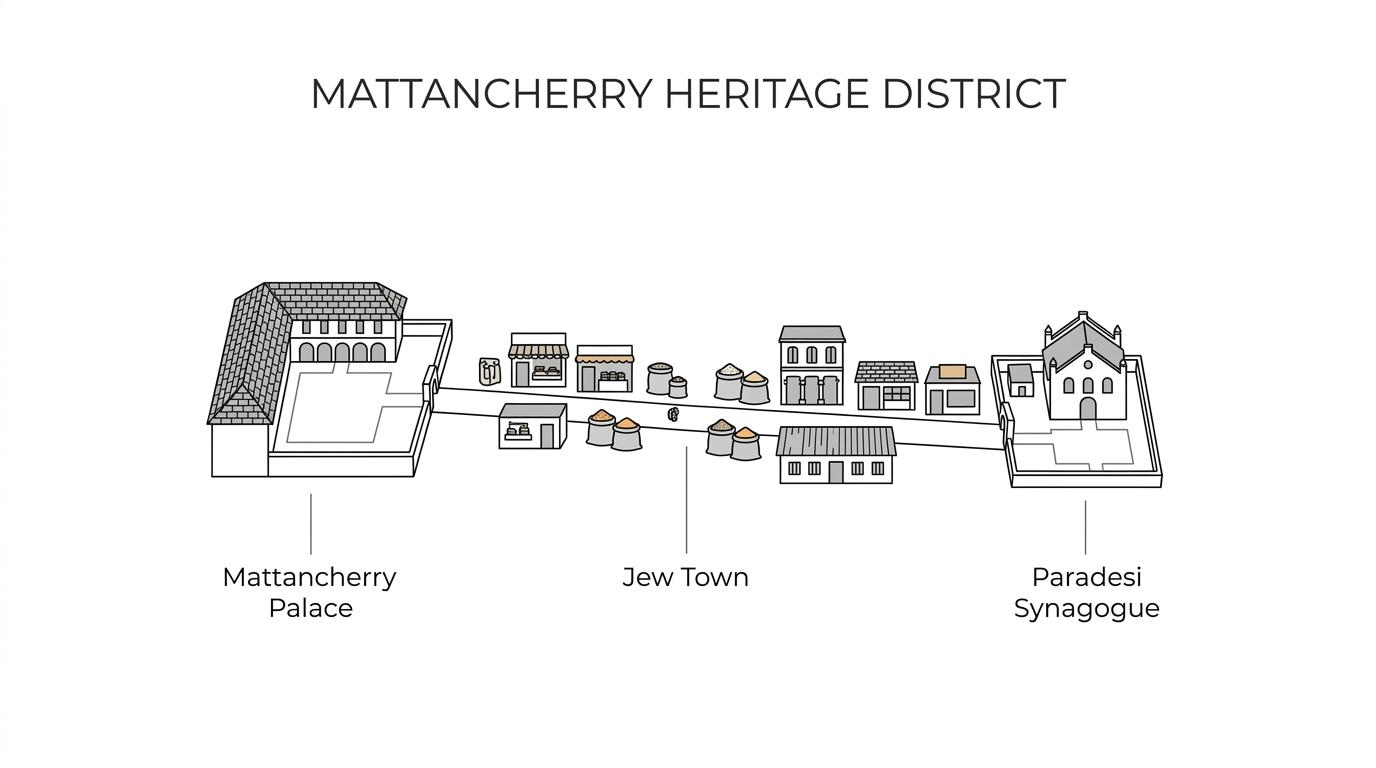
This compact setting gives Mattancherry unusual depth. A palace gifted by European traders to a local ruler stands near a street associated with Jewish settlement, spice commerce, handicrafts, and antique shops. Even today, the area still carries the feel of a place built around exchange.
A few features make this district especially rewarding:
- Historical continuity: trade, religion, and governance overlap within walking distance
- Built heritage: palace architecture, old warehouses, street-front shops, and synagogue precincts
- Sensory atmosphere
- Living commercial character
That combination is rare. Many heritage quarters are preserved as static monuments. Mattancherry still feels used, layered, and active.
Mattancherry Palace and Kochi’s royal-political history
Mattancherry Palace is one of the clearest reminders that trade in Kochi was always political as well as commercial. Kerala Tourism notes that the palace was built around 1545 CE by the Portuguese and presented to Veera Kerala Verma of the Kochi dynasty. Later, the Dutch renovated it, which is why it is widely known as the Dutch Palace.
Even that short timeline captures the shifting balance of power on the coast. European powers did not merely dock ships and buy pepper. They cultivated influence with rulers, sought favor, negotiated privileges, and inserted themselves into local statecraft.
The palace also had ceremonial value. It was used by Kochi rulers for coronations and official functions, making it more than a symbolic gift. It became part of the political life of the kingdom.
Inside, the palace is widely admired for its murals and traditional Kerala-style architectural character, reflecting the rich culture of the region. Yet its bigger value within the Mattancherry setting lies in context. This was a royal structure positioned in an area shaped by trade. That placement tells you that wealth from maritime commerce affected courtly life, diplomacy, and urban growth.
This is not just a pretty old building. It is evidence of how foreign trade, local kingship, and colonial competition met in one coastal town.
Jew Town, Jewish settlement, and the mercantile street
Jew Town carries one of the most distinctive identities in Kochi. Kerala Tourism traces its origins to Jewish migration after the 1341 flood and a land grant in 1524. That link between environmental change, migration, and settlement adds another layer to Kochi’s port history.
The street itself is known today for spices, handicrafts, and antiques. Yet behind the visitor appeal is a deeper story of community life shaped by commerce and continuity. Jewish merchants were part of a wider trading ecosystem in Kerala, one that connected port cities to inland producers and overseas markets.
The Paradesi Synagogue remains central to that identity. Even without turning the visit into a checklist of facts, the presence of the synagogue gives Jew Town its anchor. It turns the lane from a shopping stop into a place of memory, migration, and faith.
What stands out most in Jew Town is the way commerce and heritage remain close to each other. Kerala Tourism also points out that the world’s only international pepper stock exchange still functions in Jew Town. That fact alone keeps the district from being reduced to nostalgia. Pepper is not just part of the past here. It still shapes the area’s identity.
A walk through this quarter often includes:
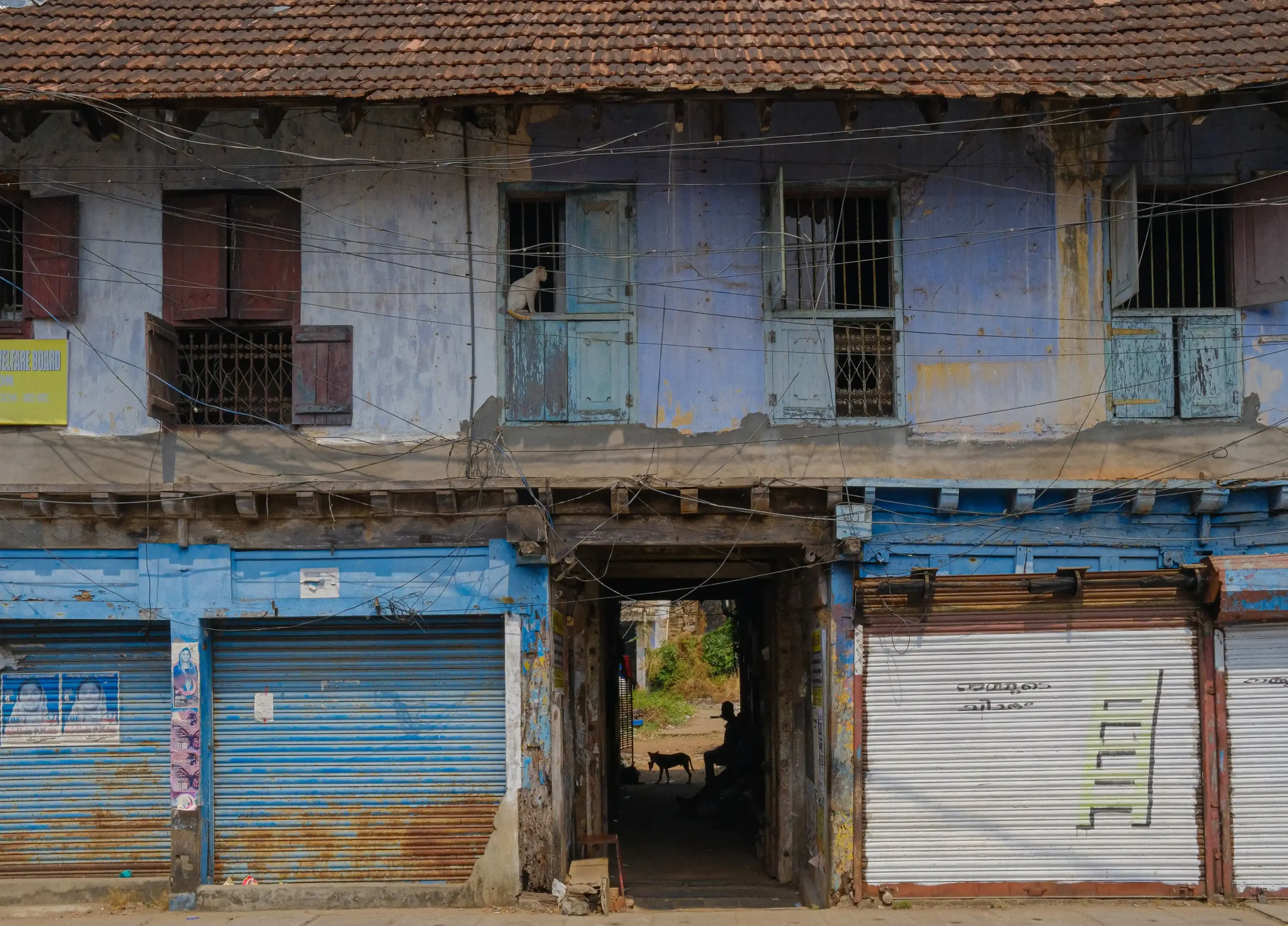
- Street character: antique stores, weathered signboards, and old wooden doors
- Trade memory: spice sacks, warehouse fronts, and the lingering scent of pepper
- Cultural significance: the synagogue precinct and the story of Jewish settlement in Kochi
- Quiet photo spots
What the spice trade still feels like in Mattancherry
The strongest heritage sites are not always the grandest ones. Sometimes they are the places where a city’s past can still be felt through texture, smell, and street rhythm. Mattancherry does this exceptionally well.
You see it in the warehouse-like buildings and old commercial facades. You smell it near spice shops and storage points. You hear it in the mix of local traffic, visitors, traders, and shopkeepers. The past here is not sealed behind glass.
This matters because Kochi’s trading history is easy to flatten into abstraction. People say “spice trade” and imagine ships, maps, and European powers. Mattancherry gives that phrase weight. Pepper had to be sorted, packed, priced, moved, financed, and negotiated. Communities settled around that process. Streets developed around it. Institutions grew because of it.
One short walk can reveal several layers at once:
- A port city rising after the decline of another port
- Foreign contact shaping local politics
- A Jewish quarter formed through migration and settlement
- Trade continuing in forms that still leave marks on the street
This is where Kochi stops feeling abstract and starts feeling tactile.
Key heritage places in Mattancherry and Jew Town
A table helps put the district’s linked sites into perspective.
| Place | Why it matters | What to notice | Suggested time |
|---|---|---|---|
| Mattancherry Palace | Connects Kochi’s rulers with Portuguese and Dutch influence | Kerala-style architecture, murals, royal setting | 45 to 60 minutes |
| Jew Street / Jew Town | Historic commercial lane tied to Jewish settlement and spice trade | Antique shops, spice stores, old facades, street atmosphere | 30 to 60 minutes |
| Paradesi Synagogue area | Anchors the Jewish heritage of the quarter | Religious heritage, lane setting, historic identity | 20 to 40 minutes |
| Spice warehouses and trading pockets | Show Kochi’s mercantile backbone beyond monuments | Sacks, storage buildings, aromas, loading activity | Variable |
| Nearby Fort Kochi links | Extend the story into colonial and maritime Kochi | Harbor-side heritage, churches, old streets | Half day or more |
This area rewards attention to transitions. The movement from palace grounds to commercial street is part of the experience, not just the space between attractions.
Why Mattancherry belongs in a Kochi itinerary
For first-time visitors to Kerala, Kochi often works well as an opening stop because it introduces the state’s long contact with the outside world and its rich culture. Mattancherry sharpens that introduction. It shows how Kerala’s famed spice history was built not only on commodities, but also on settlement, diplomacy, ritual, and urban change.
That makes it especially valuable for travelers who want more than surface-level sightseeing. A beach, harbor, or sunset can be immediately pleasing. Mattancherry offers something richer: context. After spending time here, many other places in Kerala begin to make more sense, from plantation belts in the hills to historic ports along the coast.
It also suits different travel styles. Couples often like the atmosphere and slower walking routes. Families appreciate the compact layout. International travelers usually find the district especially meaningful because it ties South India to global trade history in a concrete way.
A smart visit usually works best with a little structure:
- Morning visit for softer light and easier walking
- Palace first, then Jew Town
- Time set aside for browsing rather than rushing
- A guide if historical context matters to you
Practical tips for visiting Mattancherry and Jew Town in Kochi
Mattancherry is not a place to rush through between lunch and a sunset photo stop. The district asks for time, even if the walking distances are short.
Start with Mattancherry Palace, then continue toward Jew Town and the Paradesi Synagogue area. That sequence works well because it mirrors the way the district’s story unfolds: royal power first, community and commerce next, living trade all around.
Wear light clothing, carry water, and expect a mix of shaded and open sections. Some shops invite browsing, and some travelers spend far longer there than planned. Antique stores, handicraft outlets, and spice sellers can be very tempting, even for people who did not expect to shop.
If your wider Kerala route continues after Kochi, this stop can set the tone beautifully. It gives depth to the state’s coastal story before the scenery changes to backwaters, hill country, or temple towns in Tamil Nadu. Mattancherry does not demand spectacle. It offers something more durable: a city’s trading memory still visible at street level.