Paying for everyday travel in Kerala is usually straightforward once you know where each payment method works best. The state is well set up for digital payments in cities and major tourist hubs, yet cash still matters for many small, local transactions.
The local currency is the Indian Rupee, or INR. According to Kerala Tourism, major hotels, restaurants, and shopping centers commonly accept credit cards. The same official guidance also recommends carrying some cash for smaller purchases, taxis, and places where cards may not be accepted.
That combination is the real key for most visitors: use digital payments where they are easy, and keep enough rupees in hand for the moments when they are not.
Kerala’s economy significantly benefits from the tourism industry, which accounts for a substantial share of the state’s GDP and generates significant income for local communities. This thriving sector not only enhances the financial stability of the region but also encourages infrastructure development and boosts small and medium enterprises, making it an attractive area for investment. Tourists are recommended to be mindful of the impact their spending can have on the local budget, especially considering the cost of living, as it contributes directly to the local economy and supports community jobs. Using a combination of digital payments and cash can facilitate seamless transactions, thus promoting smoother economic interactions during their stay.
Currency in Kerala and how much cash to carry
If you are arriving in Kerala for the first time, think in terms of a mixed payment strategy rather than a cash-only or card-only plan. Larger businesses in Kochi, Thiruvananthapuram, Munnar, Thekkady, Kovalam, and popular backwater destinations are usually comfortable with cards and digital payments. Small tea shops, local auto-rickshaws, roadside fruit stalls, quick snack counters, and some market vendors may still prefer cash.
Carrying a moderate amount of cash in Indian rupees gives you flexibility without leaving you overly dependent on notes. Many travelers do well by keeping enough for a day or two of small spending, then topping up through an ATM when needed. That amount depends on your travel style, though it is wise to have smaller denominations for taxis, tips, snacks, parking, and minor entry fees.
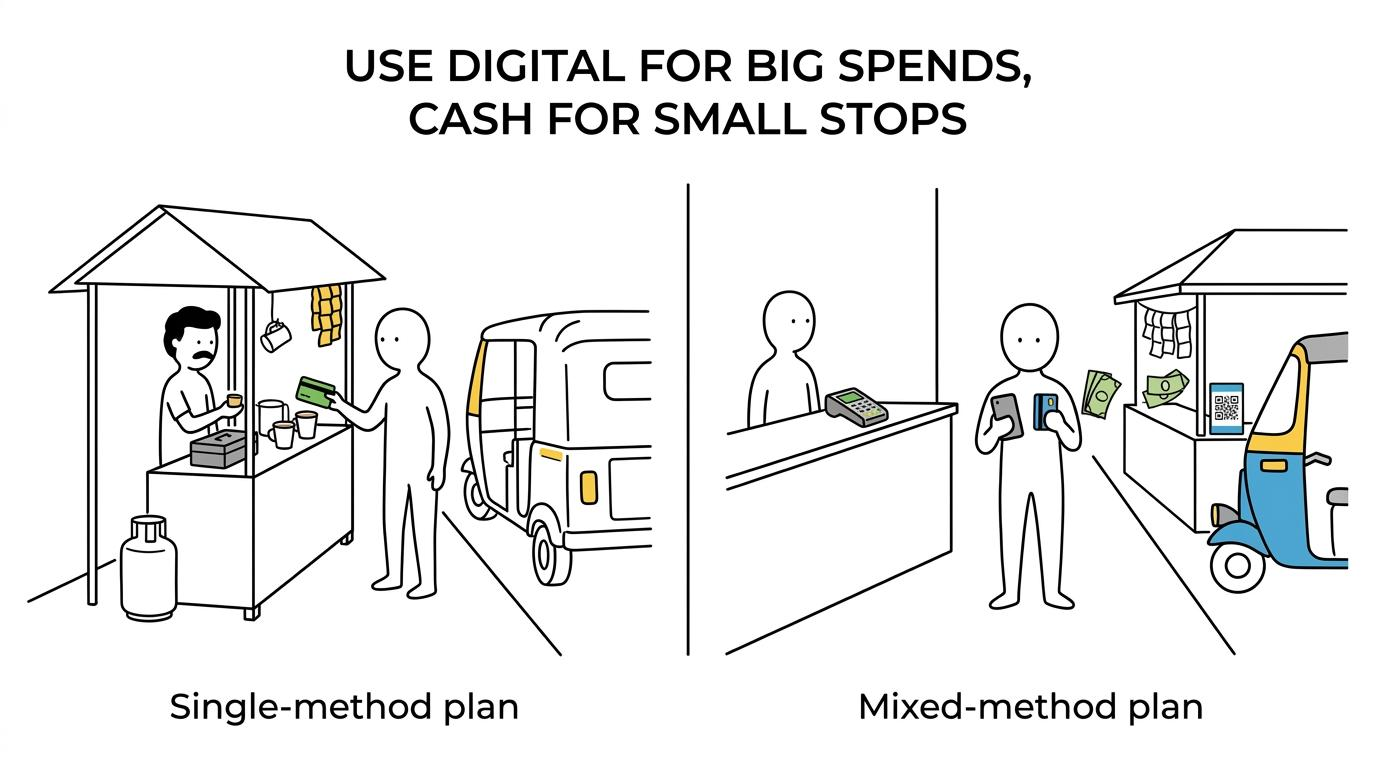
A useful way to think about it is not “How much cash do I need for the whole trip?” but “How much cash do I need until I can easily reach the next ATM or hotel?”
| Payment method | Best used for | Watch for |
|---|---|---|
| Cash | Small vendors, taxis, tips, rural stops, quick food purchases | Keep smaller notes; not every shop can break large bills |
| Credit or debit cards | Hotels, better restaurants, shopping centers, larger stores | Some places may add payment friction if network connectivity is weak |
| UPI | Everyday local payments where QR codes are displayed | Access depends on your app and banking setup |
| ATM withdrawals | Replenishing cash during the trip | Fees, withdrawal limits, and occasional machine downtime |
Using cards in Kerala at hotels, restaurants, and shops
Card acceptance in Kerala is strongest at established tourism-facing businesses. Kerala Tourism specifically notes that major hotels, restaurants, and shopping centers accept credit cards, and that lines up well with what most travelers experience on the ground. If your stay includes premium resorts, branded hotels, curated shopping, or organized activities, paying by card is usually easy.
Where card use becomes less predictable is in low-value, fast-moving, or highly local settings. A village café may prefer cash. A boat operator at a small jetty may ask for cash. A taxi driver might accept digital transfer but not cards. Even when a merchant technically has a card terminal, mobile signal or power interruptions can slow the process.
It helps to view cards as your primary tool for larger, planned expenses rather than for every tiny purchase.
A few habits make card use much smoother:
- Carry at least two cards: one primary, one backup from a different network if possible
- Expect cards at larger businesses: hotels, upscale restaurants, retail chains
- Keep cash for local spends: auto-rickshaws, snacks, market buys, parking
- Notify your bank before travel
- Check foreign transaction fees
- Save receipts for larger payments
Using UPI in Kerala for everyday travel payments
UPI has changed how India pays for almost everything. It is an instant payment system run by NPCI, an RBI-regulated entity, and it is now deeply woven into everyday commerce. In Kerala, you will see UPI QR codes in cafés, pharmacies, supermarkets, taxis, souvenir stores, and neighborhood shops. In many places, it is the fastest way to pay.
NPCI’s own product statistics show just how normal UPI has become at national scale. In May 2026, 720 banks were live on UPI, with 23,201.93 million transactions and a total value of ₹29,90,424.21 crore. Those are not niche numbers. They reflect a payment rail used constantly across India, including in Kerala.
For travelers, the practical question is access. UPI is widely accepted, but not every international visitor can use it automatically. Your ability to pay through UPI depends on your banking and app setup. If you already have a compatible arrangement, Kerala is a very convenient place to use it. If you do not, assume UPI is a helpful bonus rather than your only payment option.
The economy of Kerala has also seen a significant transformation with the widespread adoption of UPI, helping mitigate the impact of the cost of living by streamlining transactions, managing personal budget, and promoting economic growth fueled by increased investment. The digital payment infrastructure has not only boosted local commerce but also enhanced tourism by providing seamless transaction options for visitors. This financial growth reflects on the state’s capability to integrate modern banking solutions, increasing the region’s income and making it an economically progressive area that supports both residents and tourists alike.
NPCI states that the normal UPI transaction limit is up to ₹1 lakh per transaction. That is far above what most visitors need for day-to-day expenses, though banks and merchants may still apply their own controls. For coffee, local transport, museum tickets, and casual meals, UPI is often the quickest payment method available.
ATM access in Kerala and cash withdrawal rules in India
ATMs are common across Kerala’s cities, towns, airports, and busy tourist circuits, making it easy to withdraw cash in Indian rupees. That makes them the most dependable way for visitors to replenish cash as they go, rather than carrying a large amount from the start. Airport ATMs and city-center machines are especially useful on arrival, while resort areas and hill stations usually have at least some ATM access within driving distance.
That said, not every machine will be equally convenient. An ATM may run out of cash during busy periods. A machine in a quieter area may be temporarily offline. International cards can also behave differently from Indian cards, depending on the network, the issuing bank, and the machine operator.
The Reserve Bank of India says banks must provide a minimum number of free ATM transactions to customers, and charges above the free limit cannot exceed ₹23 per transaction plus applicable taxes. Those rules are helpful context, though international travelers should remember that their home bank may charge separate fees. The ATM operator may also have its own surcharge disclosures.
RBI also states that failed ATM transactions caused by technical issues, currency unavailability, invalid PINs, or similar bank-side issues are not counted as valid customer transactions. If an ATM behaves oddly, keep the receipt or note the time, location, and amount.
There is one lesser-known backup option worth knowing about. RBI allows cash withdrawal at designated merchant PoS terminals using debit cards and full-KYC prepaid cards issued by banks and non-banks in India. Credit cards are not eligible for this facility. The cap is ₹2,000 per transaction, with an overall monthly limit of ₹10,000, and charges must not exceed 1% of the transaction amount. For many foreign travelers, this may not be useful unless they hold eligible India-issued cards, yet it is still good to know the rule exists.
When using ATMs in Kerala, a few simple checks can save time:
- Use ATMs attached to bank branches when possible
- Withdraw during daytime in less familiar areas
- Keep an eye on your balance and fees
- Have a backup payment method ready
- Avoid waiting until you are down to your last few notes
Tipping in Kerala at hotels, drivers, guides, and restaurants
Tipping in Kerala is appreciated, though it is not usually treated as a rigid rule in every setting. A relaxed, respectful approach works best. If service feels attentive, professional, or genuinely helpful, a tip is a good way to acknowledge it.
Restaurants are the easiest place to start. Check the bill before tipping. Some restaurants include a service charge, while others do not. If service charge has already been added, many travelers simply round up or leave a small extra amount only when service stands out. If there is no service charge, a modest tip is a courteous choice at sit-down restaurants.
For hotels, tipping is usually more personal and service-based. Porters, housekeeping staff, and drivers tend to receive small cash tips directly. In high-end stays, this is common and appreciated. In simpler guesthouses, tipping may be less formal, but kindness and clarity still matter.
Private drivers and guides often shape the quality of a Kerala trip more than any single hotel or attraction. When they are punctual, safe, informed, and consistently helpful, tipping is a natural gesture. Many travelers prefer to tip at the end of a full day or at the close of the service period rather than handing over small amounts repeatedly.
A practical approach looks like this:
- Restaurants: round up, or leave a modest percentage if no service charge appears on the bill
- Hotel staff: small cash tips for porters and housekeeping are common
- Drivers: tip based on trip length, road conditions, punctuality, and overall care
- Guides: reward knowledge, communication, and how well the visit was handled
- Keep small notes ready
- Tip in cash when possible
Smart money planning for Kerala travel
The most reliable setup for Kerala is simple: one or two cards, access to an ATM, some cash in smaller notes of Indian rupees, and UPI if your banking arrangement supports it.
That kind of mixed setup is easiest to manage when you keep a simple view of cash withdrawals and digital spends, which aligns with My Money App’s advice on getting quick financial overview.
That mix covers almost every travel scenario, from luxury hotels and curated experiences to market shopping and roadside chai stops, making it suitable for any travel budget.
Highlighted quote advising travelers to use digital payments when convenient and keep cash for situations where they are not.
If your itinerary includes backwaters, hill stations, wildlife zones, temple towns, or long road transfers, the value of carrying backup cash rises. Not because digital payments are rare, but because convenience changes from one stop to the next.
In recent years, Kerala’s economy, along with local income, has benefited from investment and a boost in tourism, leading to better infrastructure and more modern conveniences in many areas. However, local businesses, especially in smaller towns and villages, often rely on cash transactions. Supporting these businesses through cash payments not only helps local vendors but also contributes positively to the local economy, ensuring that your travel expenses directly aid in the community’s development.
A strong day-to-day routine can be very simple:
- Pay large bills digitally
- Use cash for quick local spends
- Refill cash before remote sightseeing days
- Check restaurant bills for service charge
- Keep a backup card separate from your main wallet
With that plan in place, money matters tend to fade into the background, which is exactly where they should be when you are busy enjoying Kerala.
FAQ on Money in Kerala: ATMs, Cards, UPI, and Tipping
Traveling through Kerala means enjoying its diverse landscapes and vibrant culture without worrying about currency logistics. Here’s a quick FAQ to keep your money management seamless and efficient while you explore this beautiful region.
What currency is used in Kerala?
The currency used in Kerala is the Indian Rupee (INR).
Are credit and debit cards widely accepted in Kerala?
Yes, major hotels, restaurants, and shopping centers frequently accept credit and debit cards.
Should I carry cash and how much?
Yes, carrying a moderate amount of cash is advisable, especially for small vendors and local services.
Can I use UPI for transactions in Kerala?
Yes, UPI is widely accepted in many establishments such as local shops, supermarkets, and taxis if your banking setup supports it.
How accessible are ATMs in Kerala?
ATMs are readily available across cities, towns, and tourist areas in Kerala.
How should I handle tipping in Kerala?
Tipping is appreciated but not mandatory. Round up in restaurants, give small cash tips to hotel staff, and tip drivers based on service quality.
Is there any backup option for cash withdrawals if ATMs are down?
Cash withdrawals can be made at designated merchant PoS terminals using eligible cards, though foreign travelers may find it less useful without India-issued cards.