Understanding the Tourism Landscape in Kerala
Starting a tour business in Kerala can look simple from the outside. Build an itinerary, partner with hotels, hire vehicles, and start selling packages. In practice, the path is more structured than that.
A Kerala tour operator is not just a travel seller with a business registration. If you want to be recognized as a credible operator in the state, you need the right legal setup, tourism accreditation, documented operating capacity, and a clear grasp of GST billing rules.
That mix matters because Kerala attracts premium leisure travelers, wellness guests, family vacationers, honeymooners, and international visitors who expect reliability from day one.
What a tour operator in Kerala actually does
A tour operator is generally defined, under GST-related service treatment, as a person engaged in planning, scheduling, organizing, or arranging tours. Those tours may include accommodation, transport, sightseeing, and related services. In Kerala, that usually means combining several moving parts into one saleable experience.
That can include backwater stays, hill station itineraries, wildlife circuits, beach holidays, temple visits, chauffeur-driven transfers, local guides, and seasonal travel planning during monsoon or peak winter months.
The business model is service-heavy, detail-heavy, and reputation-heavy.
Customer reviews play a vital role in establishing the credibility and success of a tour operator in Kerala. Positive reviews from past travelers can significantly influence potential clients’ decisions, serving as a testament to the reliability and quality of services offered. Encouraging satisfied customers to share their experiences online can enhance the operator’s reputation and boost future bookings. Operators should actively seek and manage reviews to maintain high standards of excellence and client satisfaction.
A strong Kerala operator usually handles more than bookings. It also manages supplier verification, guest communication, itinerary timing, emergency support, and billing that matches tax rules.
Business registration for a Kerala tour operator
Before thinking about tourism recognition, start with the business itself. You need a legal entity, tax registrations where required, and a real operating structure.
This first stage often includes the following:
- Proprietorship, partnership, LLP, or private limited company
- PAN and bank account
- GST registration, if applicable
- Office lease or ownership proof
- Supplier contracts
- Invoicing system
Your choice of business structure depends on scale, funding, liability, and future plans. A solo consultant may begin as a proprietorship, while a business aiming for higher-value custom holidays, team hiring, and stronger vendor contracting may prefer an LLP or private limited company.
Kerala’s tourism recognition process does not replace standard business registration. It sits on top of it.
Kerala Tourism accreditation for tour operators
This is where many beginners get caught off guard. Kerala Tourism’s service-provider platform is not simply an open directory for anyone in travel. The platform is designed as a one-stop system for classification, approval, certification, and accreditation of service providers. For tour operators, that means you need to apply through the proper accreditation route before expecting a listed provider profile.
Official guidance also asks first-time applicants to create an account and review procedures and requirements before applying on the Kerala Tourism service-provider system.
According to the Government of Kerala Department of Tourism guidelines referenced for accredited tour operators, recognition is tied to specific eligibility standards. The operator must be based in Kerala and engaged in arranging accommodation, transportation, sightseeing, entertainment, and other tourism-related activities.
Here is a practical view of the main thresholds mentioned in the current guidance.
| Requirement | Kerala tour operator threshold |
|---|---|
| Business location | Must be based in Kerala |
| Paid-up capital | At least Rs. 4 lakh |
| Turnover from tour-related activities | At least Rs. 7.5 lakh |
| Office size | Minimum 500 sq. ft. |
| Staffing | At least 3 executive staff |
| Operating history | At least 2 years |
| Approval validity | 2 years, then renewal required |
These thresholds shape how you plan your first phase. A new entrant can certainly start a travel business earlier, but Kerala Tourism recognition has a higher bar than basic incorporation.
That distinction is important. You can begin operating as a travel company before you qualify for accreditation, but you should not assume instant listing access as an accredited provider.
Kerala tour operator eligibility and timing
The two-year operating history requirement changes the startup timeline in a big way. If you are launching from scratch, you may spend your first years building sales records, office infrastructure, staff depth, and financial documentation before you become eligible for recognition.
This has a few practical effects.
- You need to plan for a staged launch
- Early bookkeeping matters
- Vendor agreements should be documented from the start
- Office setup is not a cosmetic item
- Team hiring affects eligibility
A beginner often thinks the main challenge is marketing. When considering how to become a tour operator in Kerala, compliance and proof can matter just as much.
Customer reviews play a vital role in shaping a travel company’s reputation and enhancing customer trust. Positive reviews can significantly boost the company’s image, leading to increased bookings and customer loyalty, while negative reviews might serve as constructive criticism for areas needing improvement. Travel businesses should actively encourage feedback from clients and strategically use the reviews to refine their offerings and customer service, leveraging them as a marketing tool to build a strong online presence.
The approval period also has a fixed life. Recognition is granted for two years and must be renewed with the required fee and documents. If renewal is not completed as required, the approval can be cancelled automatically.
Documents and systems to prepare for Kerala Tourism accreditation
Accreditation works best when your records are organized long before you submit the application. Trying to assemble everything at the last minute usually exposes gaps in staffing records, tax filings, address proof, turnover proof, or tour operations history.
Build your document trail as part of daily business, not as a separate admin project.
A good preparation file usually includes the following:
- Business identity: incorporation papers, PAN, address proof, and bank details
- Office proof: lease deed or ownership records that support the required 500 sq. ft. office standard
- Financial proof: paid-up capital records, turnover statements from tour-related activities, and audited or accountant-certified financials where applicable
- Tax compliance: GST registration, GST returns, income tax filings, and supporting invoices
- Staff records: employee list, roles, payroll support, and proof of at least three executive staff
- Operations proof: sample itineraries, client invoices, supplier agreements, transport tie-ups, hotel contracts, and booking records
Even if some documents are not asked for in exactly the same format every time, keeping them ready reduces delay and helps you present a serious operating profile.
GST treatment for tour operator services in Kerala
GST is one of the most important parts of running a tour operator business well. Pricing can look attractive on paper and still fail in practice if the tax structure is misunderstood.
Official GST references and notifications classify tour operator services separately. The widely cited position is that tour operator services may be taxed at 5% without ITC when the notified conditions are met. Those conditions generally include that the bill is inclusive of the accommodation and transportation required for the tour, and that input tax credit is not taken.
There is also a commonly referenced 18% route with input tax credit in industry discussion and GST Council material. That difference can affect margins, invoice wording, supplier planning, and how you design packages.
Here is a simple comparison.
| GST approach | Typical treatment |
|---|---|
| 5% without ITC | Used where notified conditions for tour operator service are met and input tax credit is not claimed |
| 18% with ITC | Often discussed as the alternate treatment depending on structure and credit claim position |
This is not an area for guesswork. That caution is not unique to India either, as CBM Accounting argues in its overview of VAT support for growing companies that indirect-tax mistakes usually show up later in pricing, invoice treatment, and margin control rather than at the point of sale.
A Kerala tour operator should speak with a qualified tax professional before locking package pricing, especially when combining hotels, vehicles, guides, meals, or subcontracted services across multiple states.
Another detail that matters is place of supply. GST Council material has indicated that domestic tour-operator supplies follow the recipient-location rule for place of supply. That can affect how you invoice customers from outside Kerala even when the travel happens inside Kerala.
Pricing, invoicing, and package design for a Kerala tour operator
Tax treatment influences commercial design. A package sold as one bundled tour can be treated differently from a set of separately billed travel components.
That means your product strategy and your accounting strategy should match from the beginning.
A practical operating model usually needs clarity on these points:
- Is the trip sold as a single tour package or as separate items?
- Are accommodation and transportation included in the billed amount?
- Will the business claim input tax credit?
- How will vendor invoices be mapped to the customer invoice?
- How will cancellations and amendments be taxed and documented?
When these questions are settled early, the business looks more professional to both clients and auditors.
Building credibility in Kerala’s travel market
Kerala is a relationship-driven destination market. Hotels, houseboats, drivers, naturalists, guides, wellness centers, and local hosts all shape the guest experience. A tour operator who only chases bookings without building supplier discipline usually runs into service failures quickly.
That is why serious operators focus on supplier quality as much as sales.
Collecting and analyzing customer reviews is another crucial aspect of building a reputable tour business. Reviews offer insights into customer satisfaction and help identify areas for improvement, ensuring services meet and exceed guest expectations. Positive reviews not only enhance credibility but also serve as powerful marketing tools, showcasing real experiences to potential clients.
A credible startup should build around a few non-negotiables:
- Verified stays: know the actual room quality, service standards, location reality, and cancellation terms
- Transport discipline: use trained chauffeurs, maintained vehicles, and realistic driving schedules
- Clear costing: avoid vague package rates that later need hidden add-ons
- Guest support: keep a real point of contact during the trip
- Season planning: account for monsoon conditions, holiday rush, and regional travel time variations
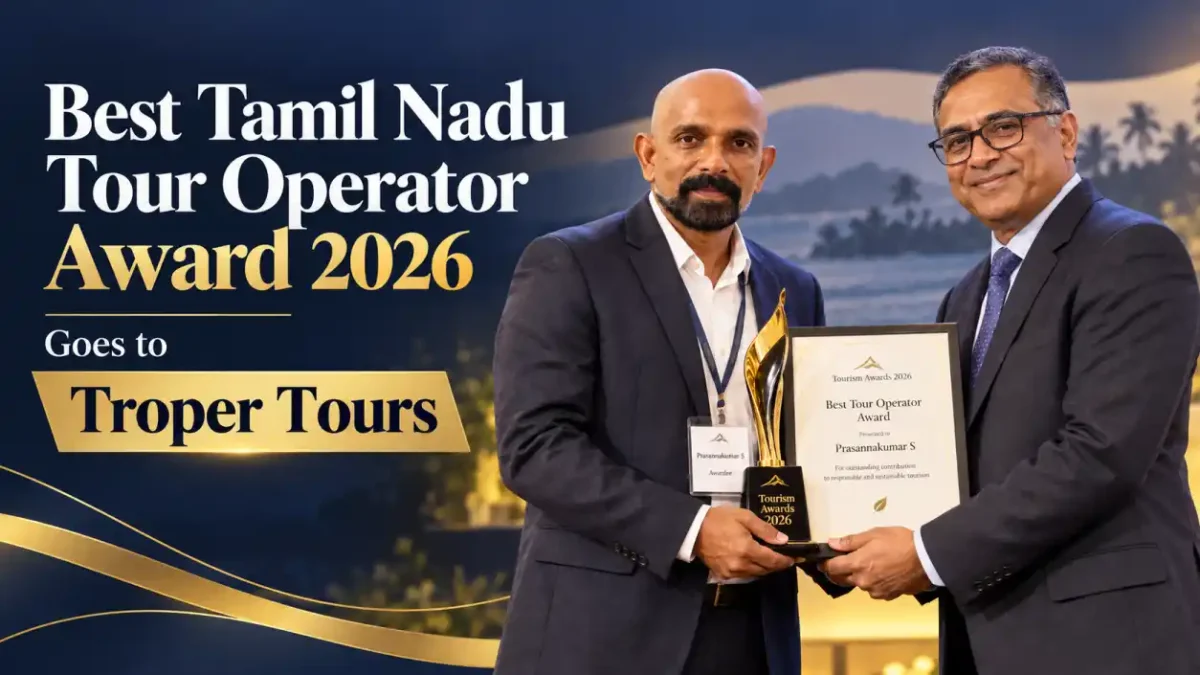
This is also where learning from established specialists helps. A company like Troper Tours reflects the kind of structured model many new operators aim for: tailor-made itineraries, verified stays, private transfers, destination depth in Kerala and Tamil Nadu, and ongoing support during the trip.
Common mistakes when starting a tour operator business in Kerala
Many early failures do not come from lack of demand. They come from weak setup.
The most common mistakes are straightforward, and avoidable.
- Confusing registration with accreditation: a business license alone does not make you an accredited Kerala tour operator
- Ignoring the two-year history rule: recognition may not be available right after launch
- Underbuilding the office setup: the 500 sq. ft. office requirement is a real threshold in current guidelines
- Hiring too late: staffing levels are part of eligibility, not just a growth choice
- Pricing without GST planning: tax treatment can reshape margin more than beginners expect
- Selling first, documenting later: weak invoices and poor records make recognition and renewal harder
A disciplined startup often grows faster than a flashy one because it can sustain quality, compliance, and referrals.
A realistic first-year plan for becoming a Kerala tour operator
If you are starting fresh, think in phases. Phase one is legal setup and product design. Phase two is supplier building and sales proof. Phase three is operational maturity. Phase four is accreditation readiness.
That sequence is more realistic than trying to look like a large operator in month one.
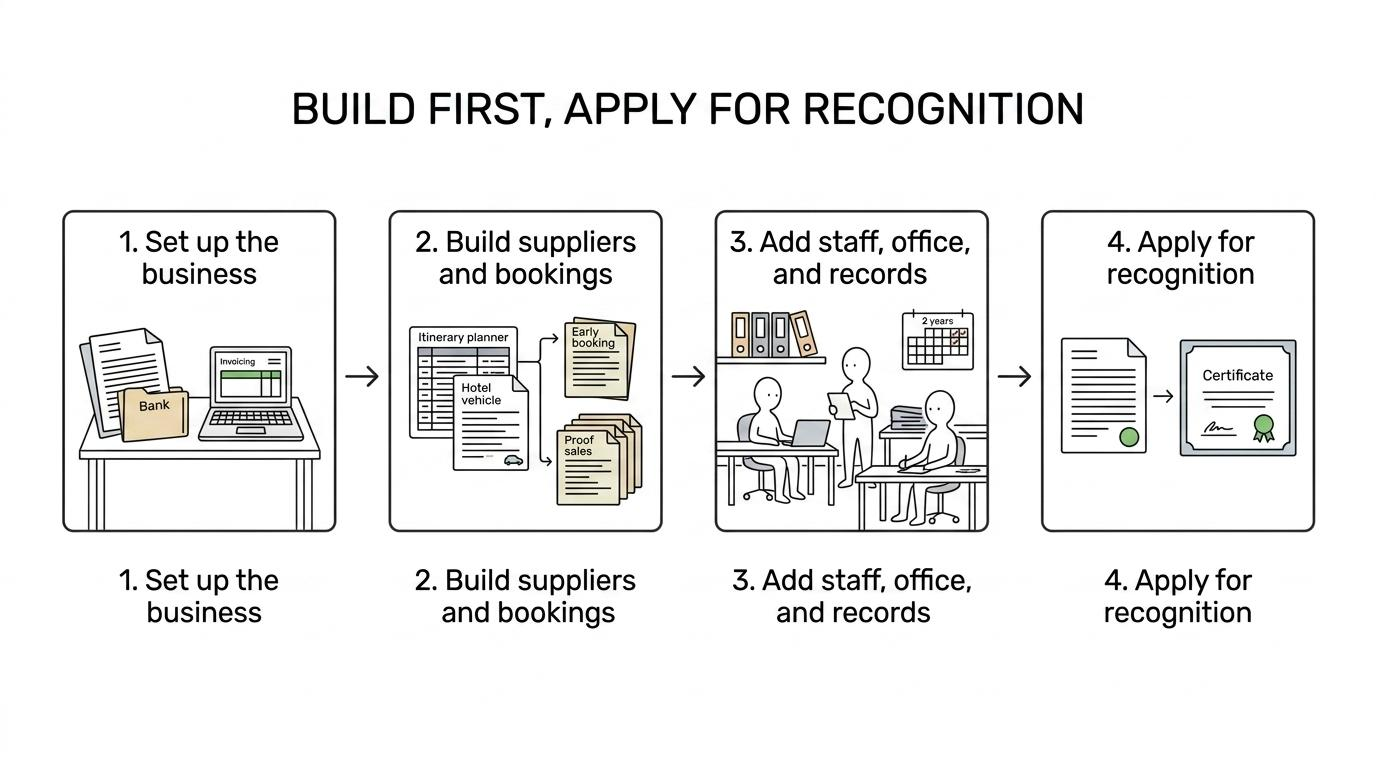
In practical terms, the first year should focus on a defined niche. You might begin with custom family holidays, luxury Kerala circuits, Ayurveda retreats, Tamil Nadu temple tours, honeymoon trips, or chauffeur-led South India itineraries. A focused niche makes it easier to standardize pricing, train staff, and build a supplier network with fewer service gaps.
Keep records from the start. Track tour-related turnover separately. Use written supplier agreements. Maintain tax filings on time. Build an office that reflects the scale you want to qualify for. By the time the operating history threshold is met, you want your accreditation file to look like a natural extension of the business you have already built, not a rushed reconstruction of it.
Understanding how to become a tour operator in Kerala and implementing a structured approach is how a Kerala tour operator moves from an idea to a recognized travel brand with staying power.
Frequently Asked Questions About Becoming a Tour Operator in Kerala
Embarking on the journey to become a tour operator in Kerala is both exciting and rewarding. Here, we address some common questions to guide you on this path.
What is the first step to becoming a tour operator in Kerala?
Begin with legal business registration such as a proprietorship, LLP, or private limited company, followed by obtaining tax registrations like PAN and GST.
What are the key requirements for Kerala Tourism accreditation?
You need to be based in Kerala, have a minimum paid-up capital of Rs. 4 lakh, a turnover of at least Rs. 7.5 lakh, an office of at least 500 sq. ft., three executive staff, and two years of operational history.
How important is GST knowledge for operating in Kerala?
GST knowledge is crucial as it affects your pricing and tax compliance. Tour operator services are typically taxed at 5% without input tax credit or 18% with it, depending on the structure.
Why is office setup significant for accreditation?
The office setup, with a minimum of 500 sq. ft., is a required standard for accreditation, reflecting your professional capacity to handle operations.
How can customer reviews impact my tour business in Kerala?
Positive customer reviews enhance credibility, influence bookings, and serve as a marketing tool to attract new clients and maintain high service standards.
What are some common mistakes to avoid?
Avoid confusing basic business registration with tourism accreditation, underestimating the two-year history requirement, and neglecting GST implications on pricing.