When travelers compare tour companies in Kerala, the word accredited can sound reassuring but also a little vague. It is often treated like a marketing label, even though it means something more specific in the Kerala tourism system.
For travelers, that distinction matters. Kerala Tourism accreditation is an official approval framework used for service providers that appear in the department’s public listings, and it comes with published entry rules, a fixed validity period, and renewal conditions. That makes it more than a decorative badge on a website.
Kerala Tourism accreditation definition for travelers
In plain terms, Kerala Tourism accreditation, explained thoroughly, means a travel service provider within the hospitality and tourism industry has been recognized by the Department of Tourism, Government of Kerala, under its approval and listing system. Kerala Tourism uses this system to publish information about accredited service providers on its official website, including tour operators and other travel-related businesses.
That official listing function is a major point for travelers. According to Kerala Tourism’s public information, travelers can use these listings to get details about approved accommodation facilities, Ayurveda centers, and tour operators in Kerala. So when a company says it is accredited, the useful question is not just “Do they have a badge?” but “Are they recognized in the official Kerala Tourism system?”
This is where the term classification also enters the picture. Kerala Tourism’s public service-provider information indicates that non-accredited providers should apply for classification, while accredited providers can register their profiles for publication on the Kerala Tourism website.
Kerala Tourism accreditation rules for tour operators
For tour operators, Kerala’s approval is not open-ended. Official guidelines state that approval is granted for two years by the Director, Department of Tourism, Government of Kerala.
That time limit is important because it turns accreditation into an active compliance status rather than a one-time milestone. If the approval period expires and the operator does not apply for renewal with the required fee and documents, the approval is automatically cancelled under the published rules.
That alone changes how travelers should read the term certification in the context of Kerala Tourism.
A valid Kerala Tourism accreditation suggests that the operator has met the department’s conditions recently enough to still hold approved status, rather than relying on an old claim from years ago.
After that point, a traveler can treat accreditation as a first-level trust filter, not a full substitute for personal research.
- Current government-recognized status
- Published entry standards
- Renewal-based validity
- Public listing value
- Better visibility for verification
Kerala Tourism accreditation requirements behind the badge
Kerala Tourism’s guidelines for approved tour operators include formal eligibility conditions. These are not abstract ideas about service quality alone. They cover business structure, financial thresholds, staffing, office infrastructure, and compliance records.
The guidelines cited in official materials include minimum paid-up capital, minimum tour-related turnover, office-size expectations, and experienced staff requirements. They also refer to tax filing and business registration requirements, which gives the approval process a clear compliance backbone.
| Requirement area | What Kerala Tourism guidelines indicate | Why it matters to travelers |
|---|---|---|
| Business registration | Operators are expected to hold proper registration and supporting legal documents | Reduces the chance of dealing with an informal or loosely documented business |
| Paid-up capital | Minimum paid-up capital requirement of Rs. 4 lakh | Signals a base level of business commitment and financial structure |
| Tour-related turnover | Minimum turnover requirement of Rs. 7.5 lakh | Suggests actual operating activity, not just a dormant setup |
| Office infrastructure | Office space requirement of 500 sq. ft. | Points to a more established operating presence |
| Staffing | At least three experienced executive staff | Indicates some operational depth beyond a one-person selling model |
| Tax compliance | Tax filing documentation is part of the approval framework | Adds another layer of accountability |
| Renewal | Approval lasts two years and must be renewed | Keeps the status time-bound and review-based |
Travelers do not need to memorize every benchmark, but the existence of these rules is meaningful. It means accreditation rests on published criteria, not only self-declared claims.
What Kerala Tourism accreditation does and does not guarantee
Accreditation is useful, but it should be read accurately, and Kerala tourism accreditation explained is crucial for understanding the detailed process involved.
It does suggest that a provider has passed a formal government approval process and remains within a system that expects renewal and continued compliance. It also tells travelers that the provider is eligible to appear in Kerala Tourism’s official accredited listings, which is a significant advantage within the tourism industry.
It does not automatically mean every itinerary will suit every traveler, every guide will be excellent, or every hotel choice will match a luxury expectation. Accreditation is not a promise of personal fit, price competitiveness, or style.
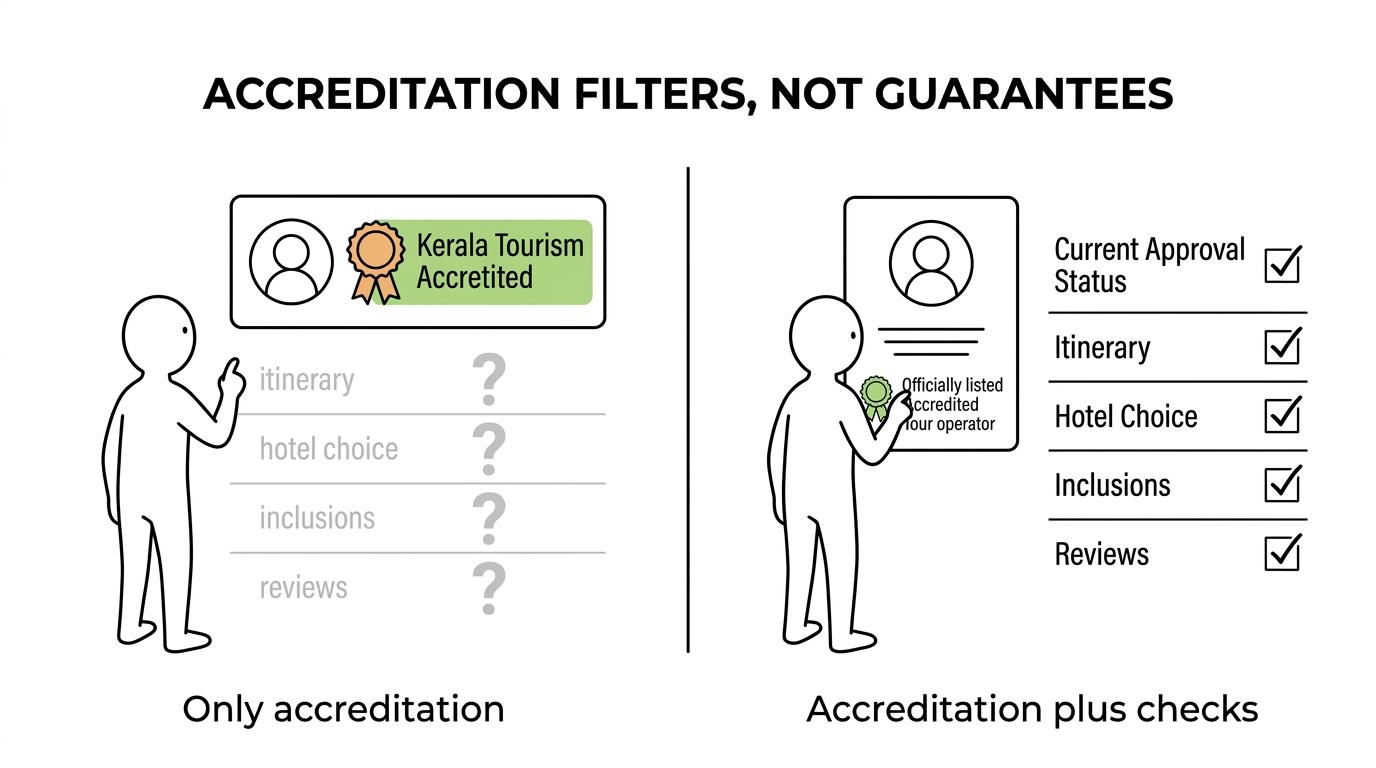
That is why the best way to use it is as a strong starting point rather than the only decision factor.
- What it confirms: The provider has entered Kerala Tourism’s approval system and met stated conditions for recognition.
- What it does not confirm: That the provider is the best match for your pace, budget, hotel preferences, or trip goals.
- What it helps with: Filtering out businesses that have no visible official recognition at all.
- What you still need to check: Itinerary quality, response time, clarity of inclusions, vehicle standards, and guest reviews.
How travelers can use Kerala Tourism accredited listings well
The smartest use of accreditation is practical. Start with the official Kerala Tourism listings, shortlist providers that match your travel style, then compare what each one actually offers.
This works especially well for international travelers, first-time visitors to South India, families coordinating multiple stops, and couples planning premium or special-occasion trips. Kerala has a wide range of travel sellers, from highly organized specialists to businesses with a lighter setup. Accreditation helps narrow the field.
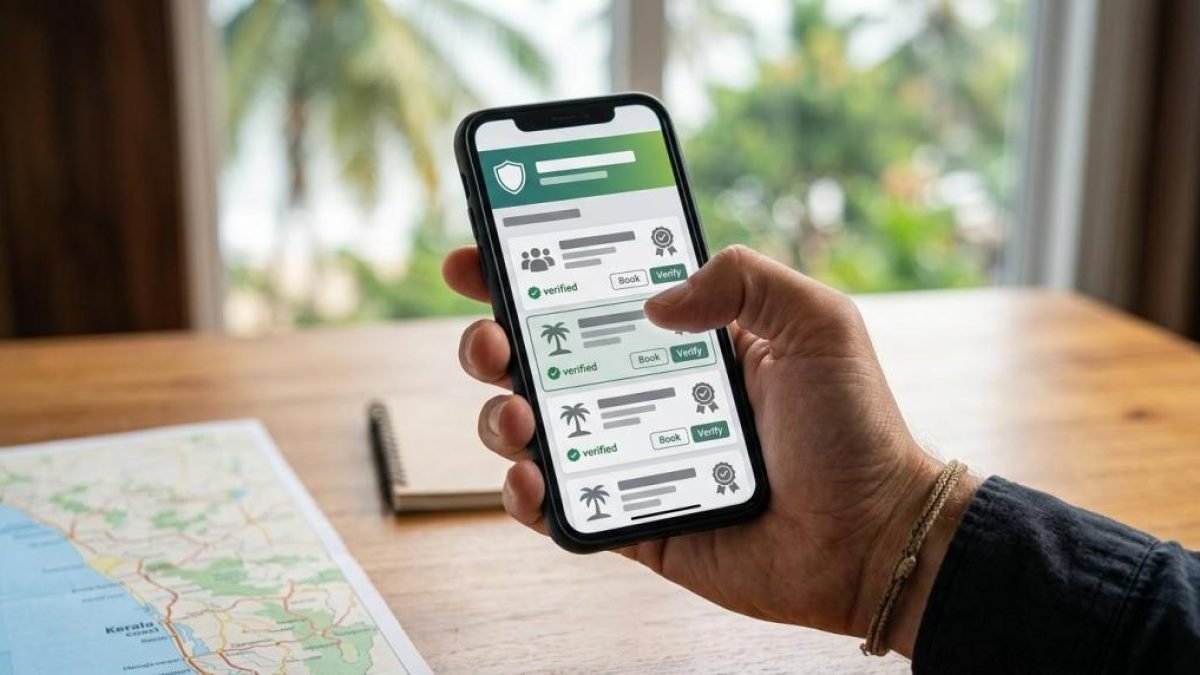
It also creates a cleaner way to cross-check claims. If an operator says it is accredited, travelers should be able to verify whether that recognition appears in Kerala Tourism’s public service-provider ecosystem and whether the profile details look current.
A sensible shortlist usually includes a few direct checks:
- Profile visibility: Look for the operator in Kerala Tourism’s official accredited or approved service-provider listings.
- Validity language: Check whether the company refers to current approval rather than an old or vague accreditation claim.
- Trip specialization: Confirm that the operator handles the type of holiday you want, whether that is luxury, family travel, honeymoon planning, wellness, wildlife, or temple-focused touring.
- Operational clarity: Review how clearly the company explains transport, accommodation categories, support, and inclusions.
- Response quality: See how well the team answers practical questions before any payment is made.
Kerala Tourism accreditation and other travel trust signals
Accreditation is one trust marker, not the only one.
A Kerala Tourism listing can sometimes show other indicators too. One official provider listing, for example, presents an operator as approved by the Government of India Department of Tourism and accredited by Kerala Tourism, while also mentioning memberships in associations such as IATO, ADTOI, CATO, ATTOI, and KTM.
That tells travelers something helpful: different forms of recognition sit side by side, but they are not identical. Kerala tourism accreditation explained shows it is its own state-level approval status. Trade memberships are industry affiliations. National approvals are another category again.
When you compare providers, these layers can be read in a balanced way:
- Kerala Tourism accreditation points to state-level recognition and listing eligibility.
- National tourism approval can indicate another level of formal review within the broader tourism industry.
- Association memberships can show professional participation in the travel trade.
- Client reviews show how real trips felt on the ground.
A company with more than one trust signal may inspire greater confidence, but the most useful pattern is consistency. official recognition, current documentation, thoughtful trip planning, and transparent communication should all point in the same direction.
When planning your trip, choosing a trusted Kerala travel agency ensures a seamless and memorable experience.
Kerala Tourism accreditation and premium travel planning in Kerala
For travelers booking a more customized holiday, accreditation becomes even more relevant. Premium trips often include multiple moving parts: private transfers, carefully chosen stays, houseboats, guided visits, wellness add-ons, and regional routing across Kerala or into Tamil Nadu.
In those cases, official recognition helps set a baseline. It suggests that the operator is not simply brokering loosely connected services without a formal operating framework.
That said, premium travel still depends on execution. A strong operator should be able to shape the trip around interests, travel pace, room preferences, food expectations, and support needs, while keeping pricing transparent. Accreditation gives confidence at the entry level; personalized planning determines whether the trip feels smooth and well judged.
This is why experienced travelers often combine official verification with a close reading of the proposal itself.
Questions travelers should ask about Kerala Tourism accreditation
Once a provider makes your shortlist, the next step is simple: ask direct questions and see how clearly they answer.
- Is your Kerala Tourism accreditation current?: Ask whether the approval is active now and whether the company can point you to its official listing or current status.
- What services do you handle directly?: Clarify whether the operator manages itinerary design, hotels, transport, houseboats, guides, and support in-house or through partner networks.
- How often do you plan trips like mine?: Ask about the exact travel style you want, whether luxury, honeymoon, family, solo, temple-focused, wildlife, or mixed Kerala and Tamil Nadu routing.
- What is included in the quoted price?: Request clear line items for stays, meals, entrance fees, transport, driver allowances, taxes, and any seasonal surcharges.
- What happens during disruptions?: Check how the company handles delays, weather changes, hotel issues, or on-trip assistance.
The best answers are usually calm, precise, and easy to verify. That is often the point where accreditation stops being a label and starts becoming part of a smarter booking decision.