Kerala’s Messi controversy has moved well past the excitement of a possible star visit by the renowned athlete. What began as a high-voltage public announcement around Lionel Messi and Argentina coming to the state is now being treated as a matter of accountability, public trust, and official scrutiny.
That shift is why the latest Messi Kerala news updates matter far beyond football fans. The issue is no longer only whether Messi would play in Kerala. It is also about what was promised, who carried responsibility, whether public money was involved, and why the public narrative changed so sharply over time.
Why the latest Messi Kerala news has become a public accountability issue
Recent reporting has pushed the row into a more serious category. State-level acknowledgment of a probe, framed around a “betrayal” of the public, shows that the controversy is being seen as more than a failed event plan. It now sits at the intersection of political messaging, sports promotion, and taxpayer accountability.
The core concern is straightforward. Kerala residents were given reason to believe that a landmark soccer event was on track. Later, official messaging shifted, and the visit was said to be off for 2025. At the same time, an RTI-based report indicated that public funds were spent on the related effort, despite earlier claims that no government money had been used.
That combination has intensified scrutiny because it raises several questions at once.
- Public messaging
- Contract responsibility
- State spending
- Sponsor obligations
- Damage to trust
How the Messi Kerala timeline changed so dramatically
The timeline is where the controversy becomes especially clear. Early messaging, bolstered by aggressive werbung, created confidence that Kerala would host Messi and Argentina in connection with a promotional and sports event effort. That confidence did not hold. By early August 2025, multiple reports said the team would not visit Kerala in 2025, with explanations ranging from scheduling issues to a collapse in the proposed match arrangement.
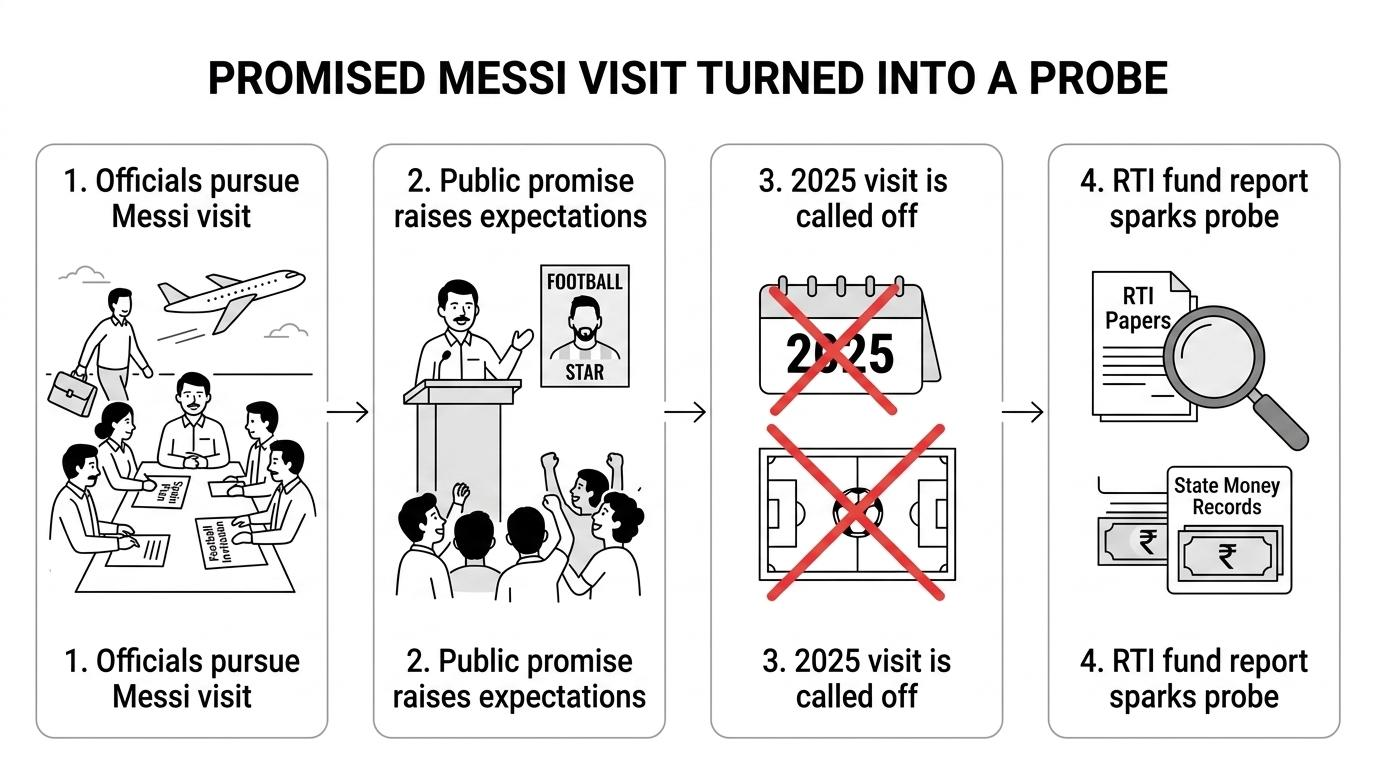
What makes the story more striking is that the change was not minor. It was a move from certainty to reversal. When public expectations are raised at that level, any later retreat is bound to draw tough questions from citizens, media, and opposition voices.
| Period | What was said or reported | Why it mattered |
|---|---|---|
| 2024 | State representatives traveled to Spain in connection with the Messi effort | Suggested serious official engagement |
| Early public phase | The Kerala side projected confidence about the visit | Created strong public expectation |
| August 4, 2025 | Reports said Messi and Argentina would not visit Kerala in 2025 due to a scheduling clash | Marked the first major official retreat |
| August 5, 2025 | Other reports described the Kerala match deal as called off after Argentina pulled out | Shifted the story toward a failed agreement |
| August 7, 2025 | RTI-based reporting tied nearly ₹13 lakh in state funds to the Spain trip | Turned the issue into a public-money dispute |
The public did not react only to cancellation. People reacted to the sense that the story itself had changed shape, and that each new report revealed a different layer of the episode.
Public money questions in the Messi Kerala controversy
The strongest new development came from RTI-based reporting by Mathrubhumi English, which said nearly ₹13 lakh from the state treasury was spent on the 2024 Spain trip connected to the Messi invitation effort. The reported delegation included the minister, the Sports Department Secretary, and the Director of Sports and Youth Affairs.
That matters because it appears to conflict with earlier statements that no public money had been spent. Once a discrepancy like that enters public debate, the issue is no longer only about a celebrity visit. It becomes a test of whether official communication was accurate and whether spending was properly explained.
For any government, this is a sensitive zone. Public funding for promotion, outreach, or event development is not unusual by itself. What matters is clarity: what was approved, what purpose it served, what outcome it was expected to produce, and whether the public was told the truth about it.
A probe worth its name would need to answer several precise points.
- Who approved the expenditure: the administrative chain behind the Spain trip
- What the spending covered: travel, meetings, promotion, or contract-related work
- What the public was told: whether earlier claims were inaccurate or incomplete
- What outcome was expected: a match, a promotional event, or a broader tourism push
- What records exist: agreements, communications, and internal file movement
A clear official account could still steady the situation. Ambiguity will only keep the story alive.
Sponsor responsibility and the contract dispute in the Messi row
The second major front in this controversy is the clash between the Kerala side and the commercial partner. Reports indicated that the sponsor accused the Argentine Football Association of cheating and said a contract had been signed for friendly matches in Kerala. That claim introduced a legal and commercial dimension that made the matter even more serious.
At the same time, public statements from the ministerial side and the sponsor reportedly pointed fingers in different directions. One side suggested responsibility lay elsewhere; the other implied there had been a breach tied to the deal. When both sides publicly distance themselves from accountability, confidence erodes fast.
That is the point at which a sports promotion story turns into a governance story.
The sponsor dispute can be read through three fault lines:
- Contract clarity: Was there a binding agreement for matches in Kerala, or only a conditional arrangement?
- Risk disclosure: Did officials and partners communicate uncertainty honestly to the public?
- Liability exposure: If commitments were presented as settled, who bears the fallout when they fail?
This area matters because many large public-facing events involve a blend of state support, private financing, rights holders, and international sports bodies. If roles are not sharply defined, public announcements can run ahead of actual certainty.
Why the Messi Kerala story matters for tourism credibility
Kerala has global recognition as a destination with strong cultural identity, high repeat appeal, and deep interest from domestic and foreign travelers alike. That image rests not only on scenery and hospitality, but also on reliability. When a widely publicized event becomes controversial, the impact can spill into how people view official destination messaging.
This does not mean one dispute defines the state. Kerala’s tourism strength is far bigger than one failed football initiative. Still, brand trust is built through consistency. Big announcements attract attention, but they also create a standard. People expect delivery, or at minimum, candor when plans hit obstacles.
For tourism and destination promotion teams anywhere, this episode offers a useful reminder: star power can boost visibility, yet credibility is what keeps long-term confidence intact. A destination gains more from careful promises that are kept than from dramatic claims that later unravel.
What this episode says about public communication in Kerala
One of the most striking parts of the Messi Kerala news cycle is how public communication appears to have outpaced certainty. That is a common risk in high-profile event planning. Momentum builds, media interest surges, and stakeholders want to project confidence. If contracts, scheduling, and funding are still unsettled, the public message can become stronger than the facts on the ground.
Good public communication does not require pessimism. It requires precision. Officials can say discussions are underway, that logistics remain subject to confirmation, or that announcements depend on final approvals. Language like that may sound less exciting in the short run, yet it protects trust when conditions change.
There is also a lesson here for audiences. Public claims tied to international sports stars, exhibition matches, or promotional tours should always be read with one question in mind: is this confirmed, or is it still contingent?
What readers should watch next in the Messi Kerala news cycle
The next phase of the story is likely to revolve around documents, not slogans. If a probe proceeds with seriousness, attention will turn to approvals, travel records, written communications, and any agreements with commercial entities or football authorities.
Readers should keep an eye on a few markers as the situation develops.
- RTI follow-ups
- Official probe terms
- Sponsor documentation
- Any legal notices
- Clarification on 2025 versus later timelines
A second marker is tone. If state officials begin speaking with more precision about what was attempted, what failed, and what public funds were used for, that would signal movement toward transparency. If the language remains broad and defensive, pressure is likely to grow.
The larger value in this story is not in the controversy itself. It is in the chance to set a better standard for public announcements, event partnerships, and financial disclosure. Kerala remains one of India’s strongest destination brands, and that strength is best protected when ambition is matched by discipline, records, and honest communication.