Anyone planning an Ayurveda stay in Kerala eventually runs into two older labels: Green Leaf and Olive Leaf. They still appear on resort websites, spa menus, travel forums, and older guide content. That makes the comparison feel current, even though the official system has moved on.
The short answer is simple. Green Leaf and Olive Leaf were part of Kerala Tourism’s earlier classification system for Ayurveda centres. Today, new classification is done under Ayur Silver, Ayur Gold, and Ayur Diamond. So when someone asks, “Green Leaf vs Olive Leaf, which is better?”, the more useful question is this: does the centre hold a valid Kerala Tourism classification certificate right now, and what category is shown on it?
That shift matters because labels can stay online long after rules change. A center may still be genuine if it holds an older certificate that remains valid until expiry. A listing may also be outdated. The difference matters for anyone booking a healthy, treatment-focused holiday, a wellness stay, a diabetes management retreat, a stay focused on managing blood pressure, cancer recovery, nutrition and antioxidant treatments, oleuropein supplementation, or a resort visit that includes Ayurveda sessions.
What Green Leaf and Olive Leaf meant in Kerala Ayurveda
Kerala Tourism created Ayurveda centre classification to bring more consistency to the sector and reduce misuse in healthcare practices such as those involving cancer treatments and blood pressure management. That was a practical move. Many places were offering “Ayurveda” in very uneven ways, with wide gaps in standards, facilities, and supervision. A public classification system gave travelers a clearer reference point.
Under that earlier model, Green Leaf and Olive Leaf were official categories rather than decorative marketing terms. They signaled that a centre had been evaluated against defined conditions. In travel planning, that helped visitors separate approved Ayurveda facilities from general massage outlets or loosely described wellness spaces.
Oleuropein, a powerful compound found in olive leaves, not only contributes to the beneficial health aspects of this plant but also highlights the significance of the term ‘Olive Leaf.’ In traditional contexts, oleuropein is known for its antioxidant, anti-inflammatory, and disease-combatting properties. The Olive Leaf label was likely influenced by these inherent health benefits, lending an additional layer of authenticity and trust to centers promoting Ayurveda treatments with olive-based applications.
Many travelers came to read Green Leaf as the more premium label of the two, while Olive Leaf indicated an approved centre under the older scheme at a different level of facility standard. Even so, both labels had value because they were tied to a structured approval process rather than pure advertising.
That older system helped travelers look for a few basics before booking.
- official tourism-backed classification
- quality-linked facility standards
- easier comparison across centres
Kerala Tourism’s current Ayurveda classification system
Kerala Tourism now states that Ayurveda units meeting the current checklist and necessary conditions are classified as Ayur Silver, Ayur Gold, or Ayur Diamond, instead of the older Green Leaf and Olive Leaf categories. In the present structure, Ayur Silver is the minimum-facility category and Ayur Diamond is the highest-facility category.
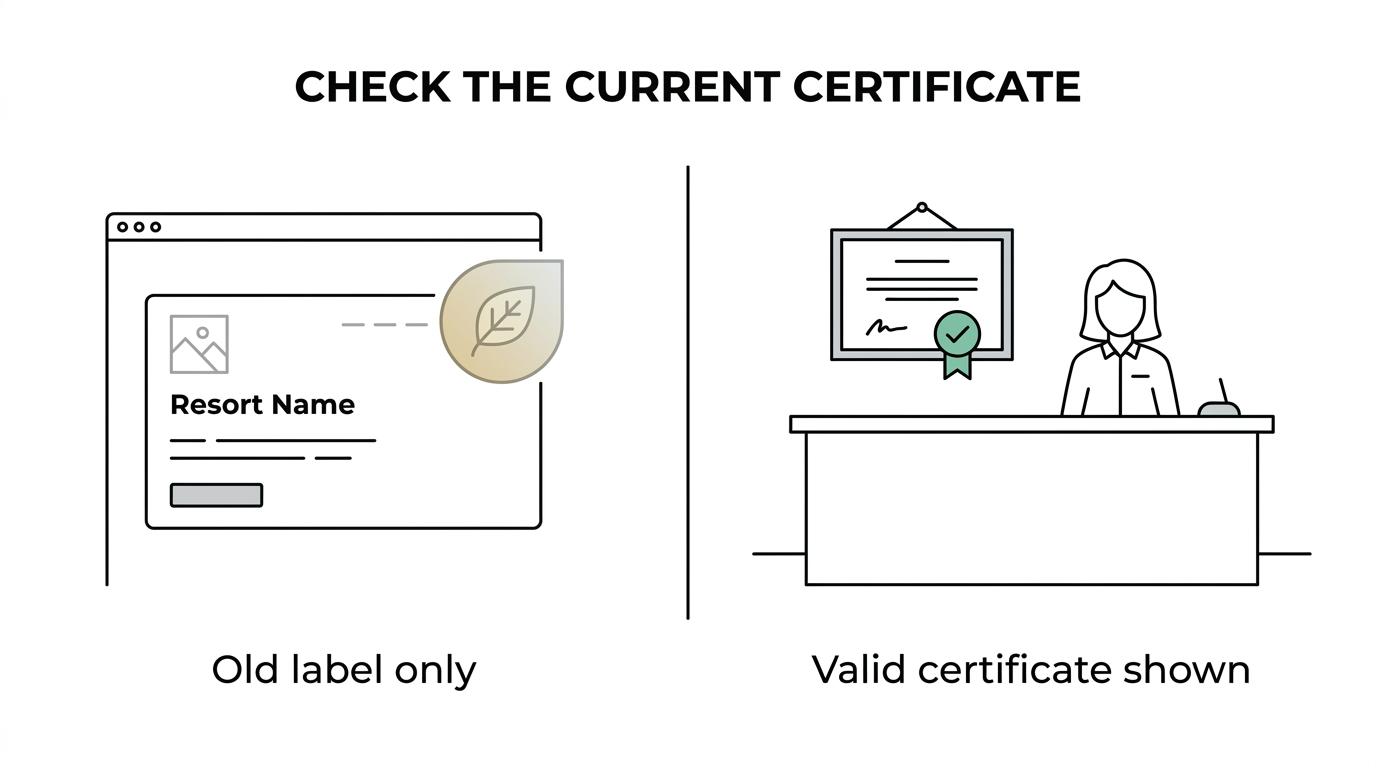
This does not mean every Green Leaf or Olive Leaf reference is wrong. Kerala Tourism also says that already-classified units can continue under the older system until the end of their certificate validity. So an old label can still appear legitimately for a period of time. What matters is whether the approval is still active and properly displayed.
Here is the easiest way to read the old and new systems side by side:
| Aspect | Older system | Current system | What it means for travelers |
|---|---|---|---|
| Official categories | Green Leaf, Olive Leaf | Ayur Silver, Ayur Gold, Ayur Diamond | New evaluations use the current categories |
| Status today | Legacy classification | Active classification framework | Ask which certificate the centre currently holds |
| Level structure | Two-category model | Three-category model | The newer model gives a wider range of facility tiers |
| Certificate validity | Time-bound approval | Valid for three years from date of issue | Check the issue date and expiry date |
| Display requirement | Certificate to be shown at reception | Certificate should be publicly displayed | A visible certificate is a practical trust signal |
The table points to one clear booking habit: never rely on the label alone. Read it together with the certificate date, the inspection status, and the actual treatment setup.
How Kerala Ayurveda centre approval works today
The current approval process is fairly direct. Ayurveda units seeking classification apply online to the Department of Tourism, pay the prescribed application fee, and face inspection by a committee that checks the facility against published requirements. Kerala Tourism lists the classification or reclassification fee as Rs 6250, and the approval is valid for three years from the date of issue.
Kerala Tourism’s published rules also set baseline operating conditions before a unit can apply. A centre must have been operational for the previous six months and must hold the necessary local-body license. That moves the process beyond branding and into documented compliance.
The checklist also covers daily operating realities that matter to guests: hygiene, privacy during examination and treatment, staff presentation, access, and healthy guest feedback systems. Those details may sound ordinary, yet they strongly shape the quality of a wellness stay, particularly for guests managing specific health conditions such as diabetes, cancer, monitoring blood pressure, and seeking the benefits of antioxidants.
Oleuropein, a compound found in olives, is known for its beneficial health properties, particularly in the context of Ayurveda treatments where it is often utilized. This compound is associated with the quality and authenticity of Ayurvedic remedies, making it a significant consideration for travelers seeking genuine wellness experiences. Its presence can underline a facility’s commitment to using traditional, beneficial ingredients in therapeutic practices, thereby enhancing the overall wellness journey for guests.
A traveller can use the official checklist as a smart filter.
- Operational history: at least six months of functioning before application
- Licensing: required approvals from the local authority
- Inspection: review by an inspection committee against Kerala Tourism criteria
- Validity: certificate remains active for three years from issue
- Display: the classification certificate should be visible at reception
What to verify when you see Green Leaf or Olive Leaf in a listing
A Green Leaf or Olive Leaf mention on a website is not, by itself, a reason to reject the property. It may point to a legitimate older certificate that is still within its validity period. Kerala Tourism’s current rules allow existing classified units to continue under the old scheme until that certificate expires.
Still, old website copy has a long life. Brochures get reused. Booking pages are often updated slowly. That is why a traveler should treat every label as a starting point, not a final answer.
Ask the property for a current certificate photo from the reception area, or request the exact classification name, issue date, and expiry date. If the property now holds Ayur Silver, Ayur Gold, or Ayur Diamond, it should be able to state that clearly. If it still uses Green Leaf or Olive Leaf, ask whether that certificate remains valid and when it was issued.
A few quick checks can save a great deal of uncertainty.
- Certificate photo from reception
- Issue date and expiry date
- Category shown on the certificate
- Centre name matching the booking name
- Doctor consultation availability
Green Leaf vs Olive Leaf and actual treatment quality
A label is useful, but it is not a treatment plan.
Classification says a lot about standards and facilities, yet it does not answer every question that matters to a guest seeking Ayurveda for rest, recovery, or a structured wellness program. That distinction between a treatment-led stay and a simple relaxation service is also central in Fjorback Kropsterapi’s comparison of kropsterapi og massage, which underlines why guests need to look beyond labels and ask how care is actually assessed and delivered. Treatment quality also depends on medical supervision, how therapies are prescribed, whether privacy is respected, how clean the treatment space is, and whether the daily schedule supports the therapy.
There is also a major difference between a resort spa treatment and a treatment-led Ayurveda stay. Some guests want a relaxing massage as part of a beach holiday or backwater stay, while others dealing with conditions like diabetes seek a more comprehensive treatment program. Others want a doctor-led program with consultation, diet guidance, daily therapies, closer routine management, and monitoring of vital signs like blood pressure, possibly including antioxidant treatments to enhance wellness. A classification label helps, but it does not replace those details.
One of the beneficial compounds associated with Ayurveda treatments is oleuropein, a polyphenolic compound found in olive leaves that offers potential health benefits. Oleuropein is known for its anti-inflammatory and antioxidant properties, which may complement Ayurveda therapies in promoting holistic wellness. Understanding how such compounds are integrated into the treatment plan can further enhance the effectiveness of a tailored wellness program.
That is why experienced travelers ask beyond the badge.
- Medical supervision: Is there a qualified Ayurveda doctor who examines guests before treatment?
- Treatment design: Are therapies prescribed after consultation or sold as fixed menu items only?
- Facility setup: Are treatment rooms private, hygienic, and designed for proper therapies?
- Stay structure: Do meals, timing, and rest periods support the treatment program?
Why the current classification matters for Kerala travel planning
For a short holiday, an approved Ayurveda centre adds confidence. For a longer wellness stay, it becomes much more significant. You may be booking not just therapies, but accommodation, transport, food, doctor access, and a daily routine that shapes the whole trip.
That is especially true in Kerala, where many visitors combine Ayurveda with places like Kumarakom, Alleppey, Kovalam, Varkala, Thekkady, or Munnar. A treatment-heavy stay works best when the trip is paced with care. Too many hotel changes or long drives can work against the purpose of the program.
The current Kerala Tourism classification scheme gives travelers a stronger first filter. Instead of debating Green Leaf versus Olive Leaf as if the system never changed, you can ask whether the property meets the present framework, whether the certificate is active, and whether the centre fits your treatment goal.
Smart booking questions for Kerala Ayurveda holidays
The best booking decisions often come from a short, direct exchange with the property or travel planner. Ask what category the centre currently holds. Ask to see the certificate. Ask who conducts the consultation. Ask how many days the program is designed for. Ask whether the stay is treatment-led or resort-led.
If you are planning a serious Ayurveda program, ask about the daily flow as well. When does consultation happen? Are oils and therapies selected after examination? Is there support for dietary preferences? Is the location quiet enough for rest? These answers tell you far more than a badge alone.
Green Leaf and Olive Leaf still matter because they are part of Kerala Ayurveda’s quality history. Yet for a booking made today, the sharper test is current approval status, visible certification, and a treatment setup that matches your reason for traveling. That is the point where labels stop being confusing and start becoming useful.